How to stop condensation in a bedroom: 10 fixes for wet windows and walls overnight
Bedrooms get the worst condensation in many UK homes: warm breath, a closed door and a cold night. Here are 10 fixes, in the order to try them, plus what a quiet dehumidifier costs to run overnight.
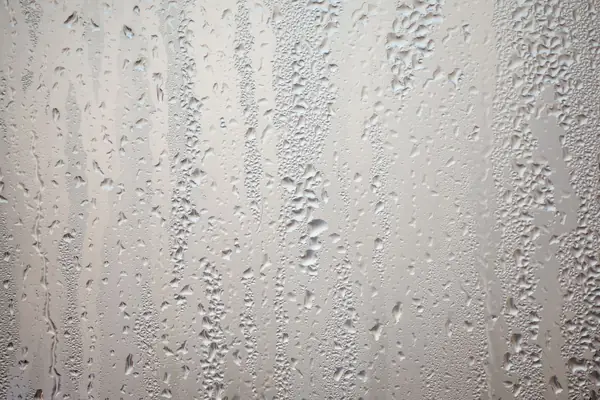
If you wake up to streaming windows, a wet window sill or damp patches in the corner of the ceiling, you're not alone. Bedrooms are where condensation is often worst: we breathe and sweat moisture into the air all night, the door's usually shut, and the heating goes off just as the walls and glass get coldest.
That moisture lands on the coldest surfaces first: the glass, the window reveal, the outside wall behind the bed or wardrobe, and the ceiling under a poorly insulated loft. Left there night after night, it turns into black mould. GOV.UK says condensation is the most common form of damp in UK homes.
Below are 10 fixes in the order we'd try them, most of which cost nothing. If you've already got mould, start with our guide to getting rid of black mould safely, then come back here to stop it returning.
Who this guide is for: Anyone waking up to wet bedroom windows, damp walls or mould spots, especially in flats, older homes with solid walls, and rooms where two people (or a baby's cot) share a small space. Renters will find the section on what to ask your landlord useful too.
Why bedrooms get so much condensation overnight
Condensation forms when warm, moist air touches a surface that's colder than its dew point. In a bedroom overnight, three things combine: moisture goes up (from breathing and sweating, plus any washing drying in the room), air movement goes down (door shut, window closed, vents blocked by curtains) and surfaces get colder as the heating goes off and the temperature outside drops.
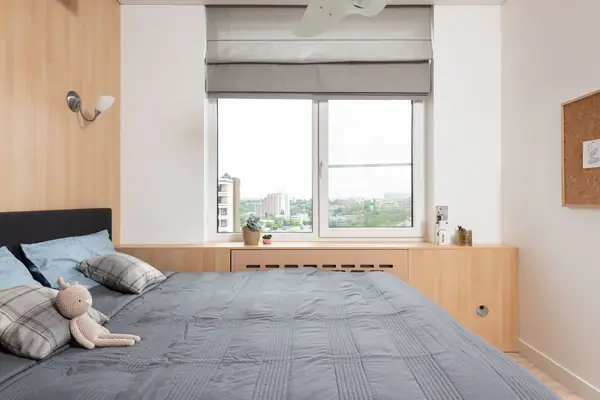
That's why the glass, the window reveal, the corner where the outside wall meets the ceiling and the wall behind the bed or wardrobe are where you'll see water, and then mould, first. It's rarely one cause, so the fixes below work best together.
10 ways to stop condensation in a bedroom

- Open the trickle vents and leave them open. They're the slots in the top of most modern window frames. GOV.UK's guidance notes that all replacement windows must have them. They let a little moist air out all night without a draught.
- Open the window for 10–15 minutes in the morning, or crack it on the latch overnight if it's safe and not too cold. Short bursts of fresh air lose less heat than leaving it open all day.
- Keep a low, steady background heat. Warmer walls are drier walls. A room that drops right down overnight gets far more condensation than one held at a modest temperature. Notting Hill Genesis suggests a thermostat setting of 18–21°C in its tenant advice.
- Leave the bedroom door open (if you can) so moisture spreads into a bigger volume of air, or run a dehumidifier if it has to stay shut.
- Don't dry washing in the bedroom. A wash load holds a lot of water, and in a closed bedroom most of it ends up on the windows. See our guide to the cheapest way to dry clothes indoors for better options.
- Pull furniture away from outside walls by a few centimetres. GOV.UK recommends leaving a gap between furniture and external walls so air can circulate.
- Keep the bathroom and kitchen doors shut when cooking or showering and use the extractor fans, so steam doesn't drift into the bedrooms.
- Wipe or vacuum the glass every morning. Clearing the water stops it soaking into frames and sills. A window vac makes this quick, and you pour the water away rather than leaving it to evaporate back into the room.
- Pull curtains back during the day and don't let thick curtains or blinds sit against wet glass overnight; tuck them behind the radiator or leave a gap.
- Run a dehumidifier overnight if the room still runs wet. This is the most reliable fix when you can't ventilate or heat enough, and quiet models cost about 29–31p a night (see below).
For condensation through the rest of the house, including the window-specific fixes, see our main guide to stopping condensation on windows.
Is it OK to run a dehumidifier in the bedroom overnight?
Yes, if it's designed for it. Look for three things: a night or sleep mode that dims the lights and turns the fan down, a humidistat so it isn't working flat out all night, and an auto shut-off when the tank is full. Place it away from the bed with space around it, on a hard, level floor, and empty the tank each morning.
Noise is subjective. Meaco quotes 35dB for the Arete Two on its low fan and from 36dB for the ABC 12L, roughly a quiet library, but compressor models also make a low hum. If you're a light sleeper, run it on its normal setting in the evening with the door shut, then switch to night mode or turn it off at bedtime. See our full roundup of the best dehumidifiers for a bedroom for more options.
What it costs to run a dehumidifier or heater overnight
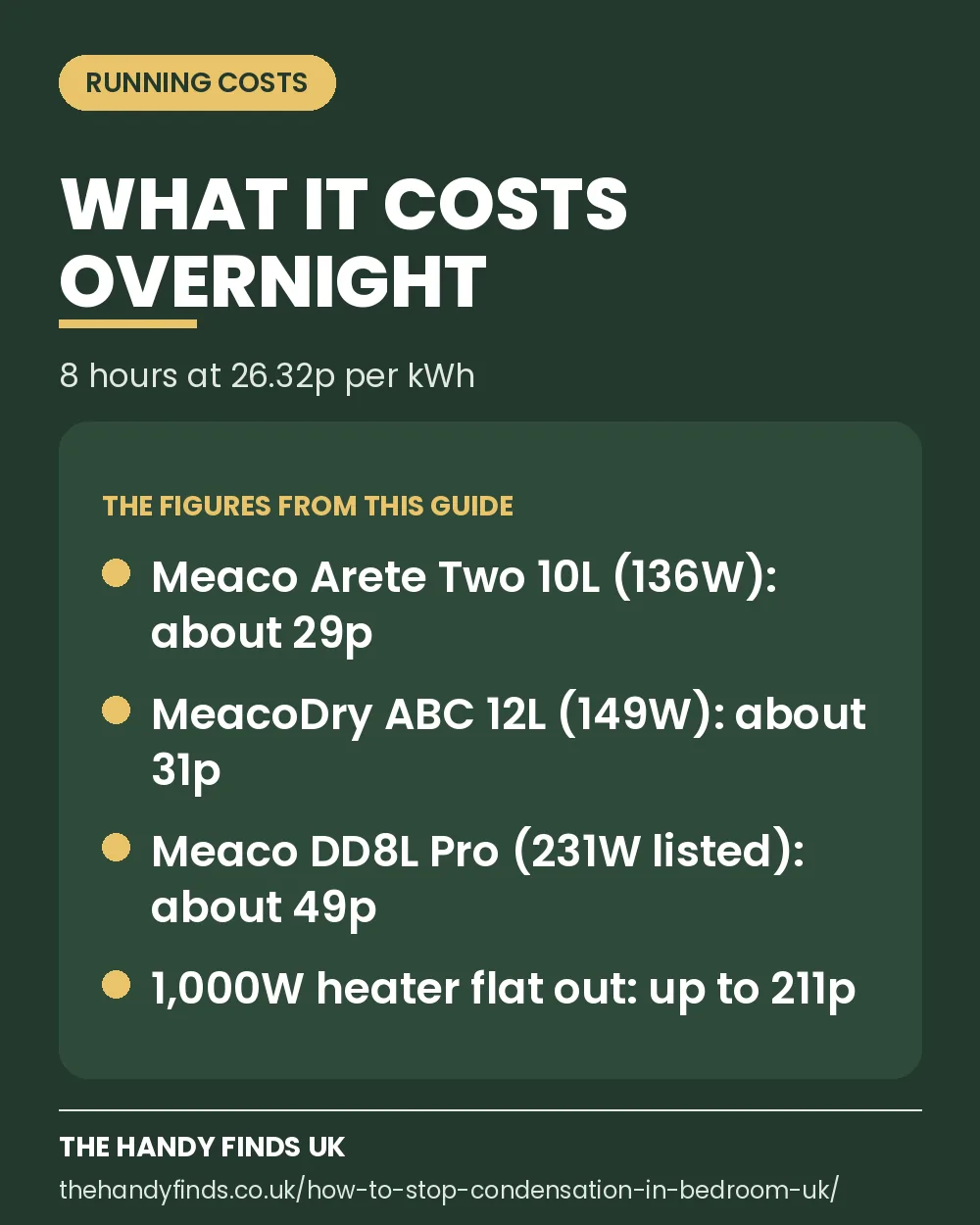
We used Ofgem's October to December 2026 cap of 26.32p per kWh and each maker's stated wattage. The working is kWh = watts ÷ 1,000 × hours, then kWh × 26.32p. Real costs are usually lower, because a humidistat or thermostat switches the machine down once the room reaches its target.
| Appliance | Working (8 hours) | Cost per night |
|---|---|---|
| Meaco Arete Two 10L (136W) | 0.136kW × 8h = 1.088kWh × 26.32p | About 29p |
| MeacoDry ABC 12L (149W) | 0.149kW × 8h = 1.192kWh × 26.32p | About 31p |
| Meaco DD8L Pro (231W listed) | 0.231kW × 8h = 1.848kWh × 26.32p | About 49p |
| 1,000W oil-filled radiator, flat out | 1kW × 8h = 8kWh × 26.32p | Up to 211p (less on a thermostat) |
| 100W electric blanket (pre-warm, 1 hour) | 0.1kW × 1h = 0.1kWh × 26.32p | About 3p |
So a compressor dehumidifier is far cheaper to run all night than an electric heater, though it doesn't replace heating in a genuinely cold room. If your bedroom is cold, see our guides to oil-filled radiators and electric blankets for cheaper ways to stay warm.
Condensation on bedroom walls and ceilings
Water on the walls, rather than just the glass, usually means the wall itself is cold: a solid outside wall, a corner where insulation is missing, or a ceiling under a patchy loft. GOV.UK suggests at least 270mm of loft insulation and points to cold spots caused by gaps in insulation.
Check behind the bed and wardrobe; that's where air doesn't move. If you see a dark tide mark low on a wall, or damp that gets worse after rain rather than overnight, it may be penetrating or rising damp, which needs a surveyor, not a dehumidifier.
A musty smell in the bedroom or wardrobe is often the first sign. Our guide to a damp smell in the house shows where to look, room by room.
If you rent: what to ask your landlord
GOV.UK's guidance for landlords in England says it's "totally unreasonable" to blame damp and mould on everyday activities like cooking, bathing and drying laundry, and that landlords are responsible for addressing damp whatever the type. Things to ask for include working extractor fans, trickle vents that open, adequate heating and insulation, and repairs to any leaks.
Report it in writing with dated photos. Shelter's damp and mould pages explain the next steps if nothing happens, and social housing tenants in England are covered by Awaab's Law timescales.
Handy products for bedroom condensation
How we chose: We based the advice on GOV.UK's damp and mould guidance, Shelter England and the Energy Saving Trust, plus the questions UK renters and homeowners ask most on Mumsnet, MoneySavingExpert and r/HousingUK. Running costs use Ofgem's October to December 2026 cap of 26.32p per kWh and manufacturers' stated wattages. We re-checked every product listing on 29 October 2026. These products have not been tested hands-on; this is a research-based roundup. How the research works.
Bedroom condensation kit compared
| Pick | Type | Power | Overnight cost (8h) | Good for | Where to buy |
|---|---|---|---|---|---|
| Meaco Arete Two 10LBest quiet dehumidifier for a bedroom | Compressor dehumidifier + HEPA filter | 136W at 20°C/60% (Meaco) | About 29p | Single bedrooms, studios, 1–2 bed flats | Meaco Amazon |
| MeacoDry ABC 12LBest budget-friendly quiet option | Compressor dehumidifier | 149W at 20°C/60% (Meaco) | About 31p | Bedrooms, flats, small houses | Meaco Amazon |
| Meaco DD8L ProBest for cold bedrooms | Desiccant dehumidifier | 231W listed; up to 623W on top fan (Meaco) | About 49p at 231W | Cold rooms that sit below 15°C | Meaco |
| TempPro TP50 hygrometerBest for checking it's working | Digital hygrometer | 1 × AAA battery | None | Any room | Check price |
| UniBond AERO 360Best for wardrobes | Non-electric moisture absorber | None | None (refill tabs) | Wardrobes, cupboards | Check price |
Specs are from manufacturer listings as of 29 October 2026; claimed figures (running costs, runtimes) are the maker’s, not ours. Check the retailer’s page for the current price and exact variant before you buy.
MeacoDry Arete Two 10L Dehumidifier & Air Purifier
Best for: Running overnight in a bedroom or small flat
- Type
- Compressor dehumidifier + HEPA filter
- Power
- 136W at 20°C/60% (Meaco)
- Overnight cost (8h)
- About 29p
- Good for
- Single bedrooms, studios, 1–2 bed flats
Meaco designed the Arete Two for small homes and single rooms, and says it works even below 10°C. It has a night mode that Meaco quotes at 35dB on the low fan speed, and a humidistat, so it stops working hard once the room reaches the humidity you set.
Meaco lists it at 136W at 20°C/60%. Over eight hours that's 0.136 × 8 = 1.088kWh, which at 26.32p per kWh is about 29p a night, and less once the humidistat kicks in. It pulls 4.19 litres a day at 20°C/60% (Meaco's figure) into a 2.5L tank, so you may need to empty it each morning in a very damp room. In stock at Meaco and on Amazon (sold by Meaco UK) when we checked on 29 October 2026.
What owners and reviewers like
- Night mode and humidistat
- Low running cost
- HEPA filter built in
- 5-year warranty (Meaco)
Watch-outs
- Small tank for a very damp room
- Modest extraction for a whole house
Check price at Meaco Also on Amazon Affiliate links · open meaco.com (via Awin) or Amazon.co.uk
MeacoDry ABC 12L Dehumidifier
Best for: A quiet, simple dehumidifier for a bedroom or flat
- Type
- Compressor dehumidifier
- Power
- 149W at 20°C/60% (Meaco)
- Overnight cost (8h)
- About 31p
- Good for
- Bedrooms, flats, small houses
The ABC 12L is Meaco's simpler compressor model and carries the Quiet Mark. Meaco quotes it from 36dB, with a humidistat and a 6-hour laundry mode for washing days.
At 149W, eight hours uses 0.149 × 8 = 1.192kWh, which is about 31p a night at 26.32p per kWh. Meaco quotes 5.18 litres a day at 20°C/60%. In stock at Meaco (black and silver; white was out) and on Amazon (sold by Meaco UK) when we checked.
What owners and reviewers like
- Quiet Mark accredited
- Simple controls
- Laundry mode for washing days
Watch-outs
- 2-year warranty, shorter than the Arete Two
- No air purifier
Check price at Meaco Also on Amazon Affiliate links · open meaco.com (via Awin) or Amazon.co.uk
Meaco DD8L Pro Desiccant Dehumidifier
Best for: Unheated or very cold bedrooms, box rooms and spare rooms
- Type
- Desiccant dehumidifier
- Power
- 231W listed; up to 623W on top fan (Meaco)
- Overnight cost (8h)
- About 49p at 231W
- Good for
- Cold rooms that sit below 15°C
Compressor dehumidifiers slow down in cold rooms. A desiccant model keeps working when the room is cold and gives off a little warmth, which helps in an unheated bedroom. Meaco says the DD8L Pro has a night mode that turns off the display lights and alerts and is engineered to run quietly in bedrooms.
It costs more to run. At the listed 231W, eight hours is 0.231 × 8 = 1.848kWh, or about 49p a night, and on the top fan setting (623W) it's about 16.4p an hour. Choose it only if your bedroom is genuinely cold; for a heated room the compressor models above are cheaper. Sold direct by Meaco; we didn't find a matching Amazon listing we could link to with confidence.
What owners and reviewers like
- Works well in cold rooms
- Adds a little warmth
- Night mode
Watch-outs
- Costs more to run than a compressor model
- Meaco direct only in our checks
Check price at Meaco Affiliate link · opens meaco.com (via Awin)
TempPro (formerly ThermoPro) TP50 Digital Thermo-Hygrometer
Best for: Seeing how humid your bedroom gets overnight
- Type
- Digital hygrometer
- Power
- 1 × AAA battery
- Overnight cost (8h)
- None
- Good for
- Any room
A cheap hygrometer tells you whether your bedroom really is too humid, and whether your fixes are working. The TP50 records the day's high and low, so you can see how far humidity climbs overnight. Sold by TempPro UK and shipped by Amazon.
As a rough guide, aim to keep the bedroom around 40–60% and below about 65% for most of the night in winter. If it hits 70% or more by morning, you'll almost certainly see condensation on the glass.
What owners and reviewers like
- Cheap and simple
- Records highs and lows
Watch-outs
- No alerts or app on this model
Check current price on Amazon Affiliate link · opens Amazon.co.uk
UniBond AERO 360° Moisture Absorber, device with 1 refill tab (450g)
Best for: Musty wardrobes and cupboards on outside walls
- Type
- Non-electric moisture absorber
- Power
- None
- Overnight cost (8h)
- None (refill tabs)
- Good for
- Wardrobes, cupboards
Wardrobes on cold outside walls are where bedroom mould often starts. A moisture trap draws a little water out of an enclosed space without power. UniBond says a tab lasts up to three months, depending on conditions. Sold by Amazon.
It won't stop condensation on bedroom windows: it absorbs a fraction of what an electric dehumidifier does. Use it in the wardrobe, and pull the wardrobe a few centimetres off the wall.
What owners and reviewers like
- No power or noise
- Good for enclosed spaces
Watch-outs
- Too small for a whole bedroom
- Refills are an ongoing cost
Check current price on Amazon Affiliate link · opens Amazon.co.uk
We use MailerLite to send emails. See our privacy policy.
FAQs
Why is there condensation in my bedroom every morning?
Overnight, breathing and sweating add moisture to the air while the room cools and the door and window stay shut. The moisture condenses on the coldest surfaces: the glass, window frames and outside walls.
Should I open my bedroom window in winter to stop condensation?
A short burst of 10–15 minutes in the morning helps a lot and loses little heat. Keep trickle vents open all the time. Leaving a window wide open all night in winter makes the walls colder, which can make condensation worse elsewhere in the room.
Is condensation in a bedroom dangerous?
The condensation itself isn't, but if it's left on surfaces night after night it leads to mould. GOV.UK says damp and mould mainly affect the airways and lungs, and some people, including children, older people and anyone with a lung condition, are at greater risk.
Will a dehumidifier stop condensation in my bedroom?
In most cases, yes, if it's sized for the room and set to around 50–55% humidity. A small compressor model costs about 29–31p for eight hours at 26.32p per kWh. Combine it with trickle vents and steady background heat.
What humidity should a bedroom be in winter?
Around 40–60% is comfortable. If it regularly climbs above about 65–70% overnight, you'll usually see condensation on the windows by morning.
Does a plant or moisture absorber stop bedroom condensation?
Not on its own. Non-electric moisture traps absorb far less than an electric dehumidifier, so they're best for wardrobes and cupboards rather than a whole bedroom.
Does a heated airer in the bedroom cause condensation?
Yes. Any washing dried in a closed bedroom releases its water into the air. If you must dry indoors, do it in another room with a dehumidifier or the window open.
Do you get commission?
Yes. If you buy through our links, Amazon or Meaco (via Awin) may pay us a small commission at no extra cost to you. It doesn't affect which products we include. See our Affiliate Disclosure.
- GOV.UK: understanding and addressing the health risks of damp and mould in the home
- Shelter England: damp and mould in rented homes
- Energy Saving Trust: fixing damp and condensation
- Notting Hill Genesis: damp and mould advice
- Ofgem: energy price cap unit rates, 1 October to 31 December 2026
- Meaco: MeacoDry Arete Two 10L
- Meaco: MeacoDry ABC 12L
- Meaco: DD8L Pro
Prices change constantly, so we don’t list them here. Always check the current price, seller and delivery details on the retailer’s site before buying. If anything on this page looks wrong or out of date, let me know.