Best desiccant dehumidifiers UK: 5 picks for cold rooms, garages and condensation
Compressor dehumidifiers struggle once a room gets cold. If your damp problem is in an unheated bedroom, a garage or a conservatory, a desiccant model is usually the better tool. Here's how to choose one.

Quick picks
- Best overall for cold roomsMeaco DD8L Compact Desiccant Dehumidifier (8L/day)Check price
- Best value and simplestEcoAir DD1 Simple MK3 Desiccant Dehumidifier (7.5L/day, rotary dial)Check price
- Best for featuresEcoAir DD1 Classic MK6 Desiccant Dehumidifier (7.5L/day, electronic control)Check price
- Best for larger or very damp spacesEcoAir DD3 Classic MK3 Desiccant Dehumidifier (11L/day, digital display)Check price
- Slimmest 10L pickEcoAir DD3 Slimline Desiccant Dehumidifier (10L/day)Check price
How we chose: We compared extraction ratings, controls, timers, tank and drainage options, weights and guarantees from manufacturer listings, read independent UK reviews from Expert Reviews, Ideal Home and T3, and looked for recurring themes in Amazon.co.uk owner feedback. We have not personally tested these products; this is a research-based roundup. Our research process.
Our main dehumidifier guide sticks to compressor models, because they're the most efficient choice in a normally heated home. But many UK damp problems happen in the cold: the spare bedroom you don't heat, a north-facing flat in January, the garage full of tools that keep rusting, or a conservatory streaming with condensation every morning. Compressor dehumidifiers slow down as the temperature falls. A desiccant dehumidifier uses a moisture-absorbing wheel (usually zeolite) and a small heater instead, so it keeps working in the cold. EcoAir rates its DD1 and DD3 Slimline to work from 1°C, and Meaco recommends desiccant for spaces below 10°C.
The trade-off is power. Desiccant models typically draw 300–650W, several times more than a typical compressor unit, although they warm the room slightly as a side effect. They're also lighter and generally quieter. The key choices are extraction rate, simple dials or electronic controls, a timer and laundry mode, and whether you need continuous drainage for a garage or outbuilding. All five picks were in stock on Amazon.co.uk with a UK delivery address when we checked.
Comparison table
| Pick | Extraction (max) | Controls | Timer | Laundry mode | Weight | Amazon |
|---|---|---|---|---|---|---|
| Meaco DD8LBest overall for cold rooms | Up to 8L/day | Electronic; 40/50/60% humidity settings | 1–8 hour off timer | Yes | 7.4kg (listing) | Check price |
| EcoAir DD1 Simple MK3Best value and simplest | Up to 7.5L/day | Rotary dial | No | Yes | 6kg | Check price |
| EcoAir DD1 Classic MK6Best for features | Up to 7.5L/day | Electronic panel | 2, 4 or 8 hours | Yes (turbo and saving) | 6kg | Check price |
| EcoAir DD3 Classic MK3Best for larger or very damp spaces | Up to 11L/day (title; spec table says 10.5L) | Digital, 40–60% in 5% steps | 2, 4, 8 or 12 hours | Yes | Check listing (7.5–8.5kg quoted) | Check price |
| EcoAir DD3 SlimlineSlimmest 10L pick | Up to 10L/day | Electronic, humidity sensor | 2, 4, 8 or 12 hours | Yes | 6.8kg | Check price |
Specs are from manufacturer listings as of 20 October 2026; claimed figures (running costs, runtimes) are the maker’s, not ours. Check the Amazon page for the current price and exact variant before you buy.
The picks in detail
Meaco DD8L Compact Desiccant Dehumidifier (8L/day)
Best for: Cold bedrooms, conservatories and garages, from a UK dehumidifier specialist
- Extraction (max)
- Up to 8L/day
- Controls
- Electronic; 40/50/60% humidity settings
- Timer
- 1–8 hour off timer
- Laundry mode
- Yes
- Weight
- 7.4kg (listing)
Meaco is the best-known dehumidifier specialist in the UK, and the DD8L is its long-running desiccant model. The listing says it extracts up to 8 litres a day, has a variable humidistat (40, 50 or 60% relative humidity), a laundry mode and an off timer from 1 to 8 hours, plus a hose outlet for continuous drainage, which is useful in a garage or holiday home. Meaco says its Control Logic cuts energy use by up to 80% once the room reaches the target humidity, and quotes about 8p an hour in laundry mode. Those are the maker's figures, not ours.
Owners say condensation clears quickly, it dries washing fast and it takes the chill off a cold room. Opinions on noise are split, with some calling it quiet and others finding it a little noisy. This is the standard DD8L. Meaco's newer DD8L Pro is rated highly by Expert Reviews and Ideal Home, but its Amazon listing had no live buy box when we checked, so we haven't linked it. The DD8L we link is sold by Big On Electricals rather than Amazon itself.
What owners and reviewers like
- UK specialist brand with good after-sales reputation
- Humidistat, laundry mode and timer
- Continuous drainage option
- Warms a cold room slightly as it works
Watch-outs
- Draws more power than a compressor model
- Noise opinions are mixed
- Sold by a third-party retailer, not Amazon
Check current price on Amazon Affiliate link · opens Amazon.co.uk
EcoAir DD1 Simple MK3 Desiccant Dehumidifier (7.5L/day, rotary dial)
Best for: A no-fuss dehumidifier for a cold room, with one dial to turn
- Extraction (max)
- Up to 7.5L/day
- Controls
- Rotary dial
- Timer
- No
- Laundry mode
- Yes
- Weight
- 6kg
The EcoAir DD1 is one of the most popular desiccant dehumidifiers in the UK, and the Simple MK3 is the stripped-back version: a single rotary dial instead of a digital panel. EcoAir rates it at up to 7.5 litres a day, says it works from 1 to 40°C, and quotes 34 dB(A) in its quiet setting. It has a washable silver-nano antibacterial filter and a laundry setting, and it weighs 6kg, so it's easy to carry between rooms. It's sold by Amazon with a two-year manufacturer's warranty.
Owners describe it as a brilliant bit of kit that pulls plenty of water out of the air and keeps condensation down. They also say it's quiet and economical, and one says it dries a full clothes horse in under four hours. The flip side of the simple design is no timer and no digital humidity reading. Durability reports vary: some owners have had theirs for seven years, while others had one fail within a year, so register the warranty.
What owners and reviewers like
- Very simple to use
- Light at 6kg
- Quiet setting rated at 34 dB(A)
- Sold and shipped by Amazon
Watch-outs
- No timer or humidity display
- Some early-failure reports
- Higher running costs than compressor models
Check current price on Amazon Affiliate link · opens Amazon.co.uk
EcoAir DD1 Classic MK6 Desiccant Dehumidifier (7.5L/day, electronic control)
Best for: Anyone who wants a timer, ioniser and auto-restart in a light desiccant unit
- Extraction (max)
- Up to 7.5L/day
- Controls
- Electronic panel
- Timer
- 2, 4 or 8 hours
- Laundry mode
- Yes (turbo and saving)
- Weight
- 6kg
The Classic MK6 is the same 6kg DD1 platform with an electronic control panel and more features. EcoAir lists a 2, 4 or 8-hour timer, laundry turbo and saving modes, a 34 dB(A) quiet mode, a built-in ioniser and a silver antibacterial filter. Its E7S economy system switches between full power, economy and standby, which EcoAir says can cut energy use by up to 40%. There's also over-dry protection, tilt and full-tank shut-off, and auto-restart after a power cut, which matters if it's running unattended in a garage.
Owner feedback on Amazon is shared across the DD1 family, and it's broadly positive. People praise how quickly it works, how quiet it is and how well it handles laundry. The same caveat applies about mixed long-term reliability. A continuous drainage hose is included. It's sold by Amazon.
What owners and reviewers like
- Timer, laundry modes and auto-restart
- Economy mode to trim running costs
- Drainage hose included
- Light and easy to move
Watch-outs
- Costs more than the Simple version
- Ioniser adds little for most homes
- Mixed long-term reliability reports
Check current price on Amazon Affiliate link · opens Amazon.co.uk
EcoAir DD3 Classic MK3 Desiccant Dehumidifier (11L/day, digital display)
Best for: Bigger cold spaces, workshops or very damp rooms where you want a humidity readout
- Extraction (max)
- Up to 11L/day (title; spec table says 10.5L)
- Controls
- Digital, 40–60% in 5% steps
- Timer
- 2, 4, 8 or 12 hours
- Laundry mode
- Yes
- Weight
- Check listing (7.5–8.5kg quoted)
If 7–8 litres a day isn't enough, the DD3 Classic steps up to about 11 litres a day in the title (the spec table says 10.5L). It adds a digital hygrometer that shows the room's humidity, five pre-set humidity levels from 40 to 60%, a 2, 4, 8 or 12-hour timer and a 4.2-litre tank with a cover to reduce spills. EcoAir quotes 36 dB(A) and supplies a continuous drainage hose. The bullets mention a three-year warranty while the spec table says two, so check the guarantee on the listing before you buy.
Owners say it's effective and quiet. Several mention the useful warmth it gives off in cold weather, and some say it works out cheaper than putting the central heating on in a damp room. Feedback on the tank is mixed: people are surprised by how much water it collects, but some find it awkward to empty. It's heavier and pricier than the DD1, and it's sold by Amazon.
What owners and reviewers like
- Highest extraction of our picks
- Humidity readout and set points
- 4.2L tank and drainage hose
- Up to 12-hour timer
Watch-outs
- Bigger and heavier than the DD1
- Tank can be awkward to empty
- Listing is inconsistent on warranty
Check current price on Amazon Affiliate link · opens Amazon.co.uk
EcoAir DD3 Slimline Desiccant Dehumidifier (10L/day)
Best for: Workshops and garages where you want 10L/day in a lighter, slimmer unit
- Extraction (max)
- Up to 10L/day
- Controls
- Electronic, humidity sensor
- Timer
- 2, 4, 8 or 12 hours
- Laundry mode
- Yes
- Weight
- 6.8kg
The DD3 Slimline puts DD3-level extraction (up to 10 litres a day, per EcoAir) into a 6.8kg body with a carry handle. A built-in humidity sensor switches the unit off when the room reaches your target and back on when humidity rises. It has a 2, 4, 8 or 12-hour timer, a laundry mode, a 39 dB(A) quiet mode, a washable antibacterial filter, an automatic louvre and a 3-litre tank, with a 1m drainage hose supplied.
It has far fewer owner reviews than the DD1, but the feedback so far is positive. One owner says it dried out a damp workshop, and others praise the build quality and say it's quieter than older EcoAir models. Like every desiccant unit, it gently warms the room. It's sold by EcoAir's own store on Amazon rather than by Amazon.
What owners and reviewers like
- 10L/day in a 6.8kg body
- Humidity sensor with auto on/off
- Timer up to 12 hours
- Drainage hose included
Watch-outs
- Fewer owner reviews so far
- Smaller 3L tank than the DD3 Classic
- Sold by the brand, not Amazon
Check current price on Amazon Affiliate link · opens Amazon.co.uk
Desiccant or compressor: which do you need?
Compressor (refrigerant) dehumidifiers condense water on cold coils. They're the most efficient choice in a heated home, roughly 15°C and above, and our main dehumidifier guide covers the best of them. As rooms get colder, their coils can frost up and extraction drops away.
Desiccant dehumidifiers pull moist air through a rotating absorbent wheel, then use a small heater to drive the water out into the tank. Meaco's listing says desiccant is the best choice if your space is below 10°C. Choose one for unheated bedrooms, conservatories, garages, workshops, boats and caravans, or if you want something lighter and quieter. In a cold bedroom, an electric blanket warms the bed for pennies while the dehumidifier deals with condensation.
Running costs: do the maths
Desiccant units use more electricity than compressor models, so running time matters. The sum is simple: watts ÷ 1,000 × hours × your unit price. A 300W unit running for eight hours uses 2.4kWh; at an illustrative 25p per kWh that's about 60p. A 650W unit over the same time costs about twice as much. Check your tariff's unit rate on your bill or the Ofgem price cap page.
Real costs are usually lower, because a humidistat switches the heater off once the room reaches the target, and some of the energy comes back as warmth in the room. A target of around 50–60% relative humidity is enough to stop condensation and mould for most homes. Running at 40% just costs more.
Drying laundry with a desiccant dehumidifier
Put the dehumidifier and the airer in a small room, shut the door and choose laundry mode. Space items out so air can move between them. Desiccant models are good at this because their warm, dry output speeds up evaporation. Makers' laundry claims (such as Meaco's six hours) are best-case figures. Heavy towels and jeans take longer. If you want something quieter, a heated airer paired with a dehumidifier works well.
Garages, outbuildings and continuous drainage
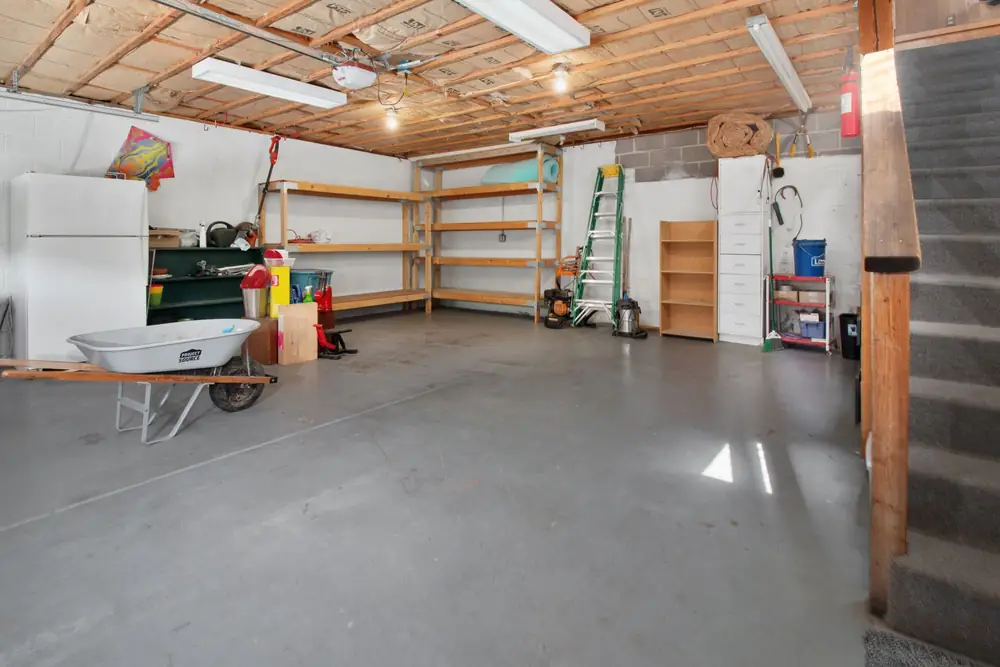
In a garage or workshop you won't want to empty a tank every day. All five picks support continuous drainage through a hose, but it only works by gravity, so the hose needs to run downhill to a drain or outside. Keep the unit off damp floors, away from dust and sawdust where possible, and clean the filter regularly. Check that auto-restart is listed if you're relying on it after power cuts. Drier air also helps protect tools, bikes and a stored pressure washer (Kärcher advises storing them dry and frost-free), and a cordless vacuum makes it quick to clear dust and sawdust from around the unit.
Safety and maintenance
Use a dehumidifier plugged straight into a wall socket, not an extension reel, and keep the air inlet and outlet clear. Desiccant units get warm at the outlet, so don't cover them or dry clothes on top of them. Clean or replace the filter as the manual says, and empty and rinse the tank now and then to stop it smelling. A dehumidifier treats the symptom. Persistent damp can come from leaks, blocked gutters or rising damp, so investigate the cause too, especially if you rent.
FAQs
Are desiccant dehumidifiers expensive to run?
They use more power than compressor models, typically 300–650W when running flat out. Thanks to humidistats and economy modes, a few hours a day in a cold room usually costs well under the price of running central heating for the same time. Use the watts × hours × unit price sum to estimate your own cost.
What temperature do you need a desiccant dehumidifier for?
As a rule of thumb, if the space regularly sits below about 10–15°C, desiccant is the better choice. Meaco's listing recommends desiccant below 10°C, and EcoAir rates its DD1 and DD3 Slimline to work from 1°C.
Can a desiccant dehumidifier dry clothes?
Yes, and they're good at it, because they blow out warm, dry air. Use laundry mode in a small closed room with the washing spaced out on an airer.
Is a desiccant dehumidifier good for a garage?
Yes, it's the best type for an unheated garage, shed or workshop. Use continuous drainage so you don't need to empty the tank, and keep the filter clean. If you store cordless drills and batteries out there, check the maker's guidance on storing batteries in the cold too.
Does a desiccant dehumidifier heat the room?
A little. The heater inside raises the outlet air temperature, so the room usually warms by a degree or two. That's a bonus in winter but no substitute for heating. To actually warm a cold room, see our oil-filled radiator guide.
Do you get commission?
Yes. If you buy through our links, Amazon may pay us a small commission at no extra cost to you. It doesn't affect which products we include. See our Affiliate Disclosure.
Sources we consulted
- Expert Reviews: Meaco DD8L Pro review
- Ideal Home: Meaco DD8L Pro desiccant dehumidifier review
- T3: Meaco DD8L Pro review
- Which?: how to buy the best dehumidifier
- Ofgem: energy price cap
Prices change constantly, so we don’t list them here. Always check the current price, seller and delivery details on Amazon before buying. If anything on this page looks wrong or out of date, tell us.