Damp smell in the house: what causes it, how to find it and how to get rid of it
A musty smell is your nose telling you something is staying damp. Here's how to track down where it's coming from, room by room, why it can mean hidden mould, and the fixes that get rid of the smell rather than covering it up.

That stale, earthy, slightly sour smell you notice when you come home, or when you open a wardrobe or cupboard, is the smell of damp. It comes from mould and bacteria growing on something that hasn't dried out, and it's one of the earliest signs of a damp problem.
GOV.UK's damp and mould guidance treats a mouldy smell as a sign of damp, and warns that a smell of mould with no mould in sight can mean mould is growing out of view: behind wallpaper, panelling or furniture, or under carpets. So don't just mask it with air freshener. Find the source.
Below: the usual causes room by room, how to track down a hidden source, what fixes it, and when it's your landlord's job. If you can already see black spots, go straight to our guide on how to get rid of black mould.
Who this guide is for: Anyone with a musty or damp smell in a room, a wardrobe, a cupboard or on clothes and towels, with or without visible mould. If anyone at home has asthma, a lung condition or a weakened immune system, GOV.UK says they're at greater risk from damp and mould, so act sooner rather than later.
What causes a damp smell? Room by room
| Where you smell it | Likely cause | What to check |
|---|---|---|
| Bedroom | Condensation from breathing overnight in a closed, cool room | Wet windows in the morning; behind the bed and wardrobe on outside walls |
| Wardrobe or cupboard | Still air against a cold outside wall; clothes put away damp | The back panel and the wall behind; the corners of the floor |
| Bathroom | Shower steam with a weak or unused extractor fan | The ceiling, the sealant, behind the bath panel, under the basin |
| Kitchen or utility | Washing machine seal and drawer, a slow leak under the sink | The seal folds, the detergent drawer, the cupboard floor under the sink |
| Whole house on washing days | Laundry drying indoors | Humidity readings on drying days compared with other days |
| Ground floor, low on walls | Rising or penetrating damp, or a leak | Tide marks, flaking plaster, damp skirting boards, blocked gutters outside |
| Top-floor ceilings or corners | Missing or patchy loft insulation, or a roof leak | Dark patches near the eaves; the loft itself |
GOV.UK's guidance says condensation is the most common cause of damp in homes, from everyday activities such as cooking, showering and drying clothes. But penetrating damp, rising damp and leaks can smell just the same, so don't assume.
How to find a hidden damp smell
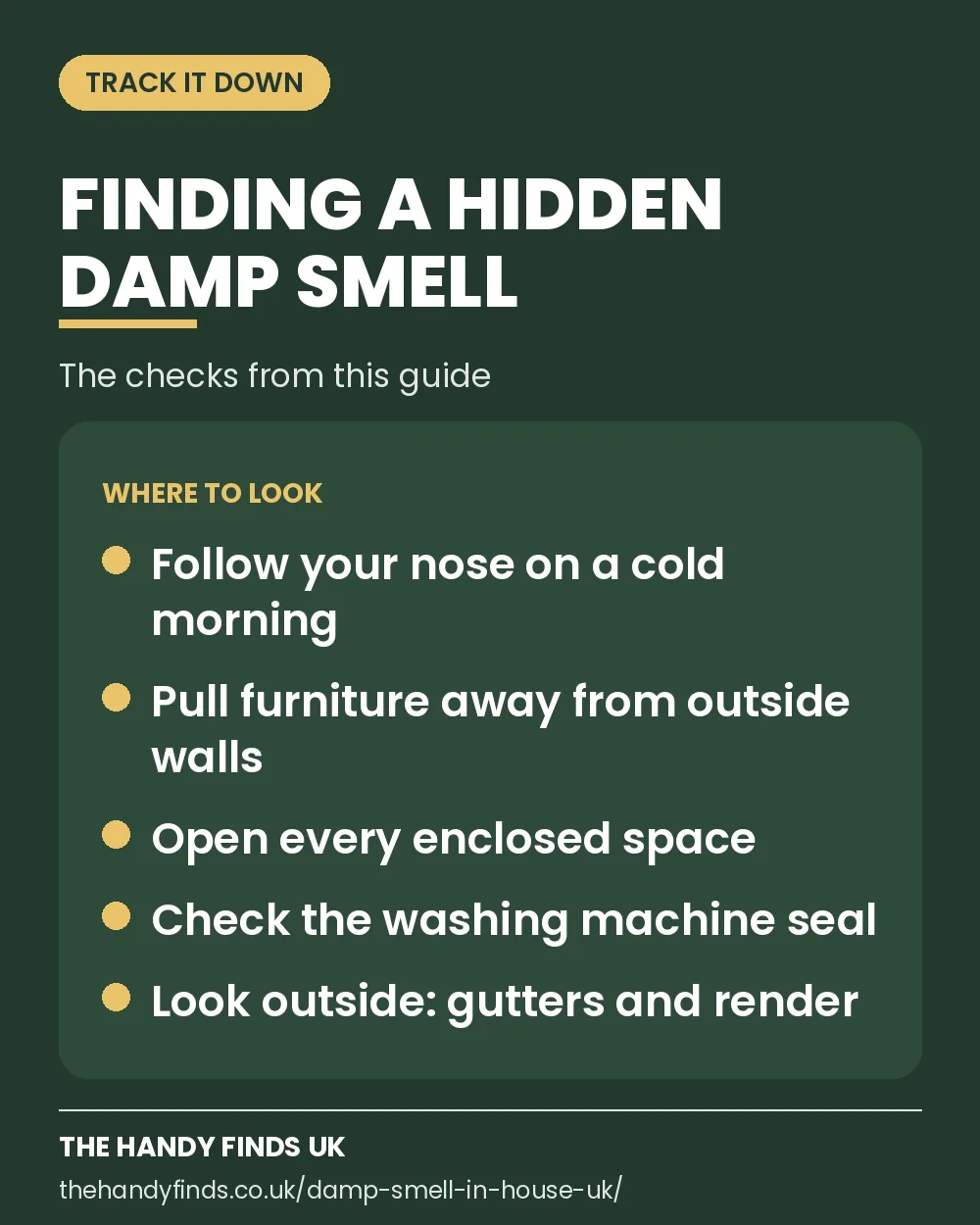
- Follow your nose on a cold morning, when the smell is usually strongest, before you open windows.
- Pull furniture away from outside walls: beds, wardrobes, sofas and bookcases. Look and sniff behind them.
- Open every enclosed space: wardrobes, under-stairs cupboards, the cupboard under the sink, behind the bath panel if it comes off.
- Lift a corner of carpet on an outside wall, if you can, and feel the underlay.
- Check the washing machine seal, drawer and filter.
- Measure: a hygrometer in each room for a day tells you whether you're dealing with general humidity or one specific spot.
- Look outside: blocked or overflowing gutters, cracked render and earth piled up above the damp-proof course can all let water in.
GOV.UK warns that disturbing hidden mould can release a lot of spores, so if you find a large area behind wallpaper or panelling, don't pull it apart yourself. Larger areas should be dealt with by qualified professionals.
How to get rid of a damp smell for good
- Dry the air. Ventilate daily, run the bathroom and kitchen extractor fans, keep trickle vents open and keep some steady background heat on. GOV.UK recommends leaving a gap between furniture and external walls so air can circulate.
- Run a dehumidifier in the worst room if humidity stays above about 60–65%. At 26.32p per kWh, a 136W compressor model costs about 3.6p an hour, so eight hours is 0.136 × 8 = 1.088kWh, or about 29p.
- Clean small patches of mould with a mould and mildew product, not bleach, as GOV.UK recommends.
- Wash or replace what smells. GOV.UK says absorbent things that have gone mouldy, such as carpets and soft furnishings, may need to be thrown away, because they can be impossible to clean fully.
- Fix leaks and outside defects: gutters, pipework, roof tiles and render. No amount of airing fixes water coming in.
Air fresheners, candles and bowls of bicarbonate of soda only cover the smell. If it comes back within days, the source is still there.
Damp smell but no visible damp?
This is common, and it usually means one of three things: the humidity is high but nothing has visibly grown yet (a hygrometer will show this), something enclosed is damp (a wardrobe, the washing machine, a cupboard), or mould is growing out of sight behind a surface. GOV.UK specifically mentions wallpaper, panelling and furniture.
A smell that gets worse after heavy rain points to water getting in from outside, such as a gutter, a roof or a wall, rather than condensation. That's a job for a builder or surveyor, or your landlord.
If you rent
GOV.UK's guidance for landlords in England says damp and mould should be tackled promptly, that landlords are responsible for addressing it whatever the type of damp, and that it is "totally unreasonable" to blame it on tenants' lifestyle choices. Report a persistent damp smell in writing with the date, where it is, any photos and humidity readings, and ask for an inspection.
In England, social landlords must also investigate and fix damp and mould hazards within set timescales under Awaab's Law, in force since 27 October 2025. Shelter can advise if your landlord doesn't act. For condensation-specific fixes, see our guides on condensation on windows and condensation in a bedroom.
Handy products for a damp smell
How we chose: We based the causes and health advice on GOV.UK's damp and mould guidance, the washing machine points on AEG's support pages, and running costs on Ofgem's October to December 2026 price cap. Products are ones we already cover in our damp and condensation guides, re-checked on Amazon UK and Meaco on 29 October 2026. We haven't visited your home, so if the smell persists, get a professional to look. These products have not been tested hands-on; this is a research-based roundup. How the research works.
Products compared
| Pick | Type | What it does | Power | Good for | Where to buy |
|---|---|---|---|---|---|
| TempPro TP50 hygrometerBest for finding the cause | Digital hygrometer | Shows humidity and temperature | 1 × AAA battery (included) | Comparing rooms, checking a fix works | Check price |
| Meaco Arete Two 10LBest for a damp-smelling room | Compressor dehumidifier | Pulls water out of the air into a tank | 136W at 20°C/60% (Meaco) | Flats, bedrooms, single rooms | Meaco Amazon |
| UniBond AERO 360Best for wardrobes and cupboards | Non-electric moisture absorber | Crystals soak up moisture into a tray | None | Wardrobes, cupboards, box rooms | Check price |
| Dr. Beckmann Service-it Deep CleanBest for a smelly washing machine | Washing machine cleaner | Cleans residue from the drum and pipes in a hot empty wash | None (used in your machine) | Musty washing, a smelly drum | Check price |
| HG Mould Remover SprayBest mould remover | Mould and mildew spray | Removes mould and mildew stains | None | Walls, tiles, sealant, window seals | Check price |
Specs are from manufacturer listings as of 29 October 2026; claimed figures (running costs, runtimes) are the maker’s, not ours. Check the retailer’s page for the current price and exact variant before you buy.
TempPro (formerly ThermoPro) TP50 Digital Thermo-Hygrometer
Best for: Checking which rooms are damp enough to smell
- Type
- Digital hygrometer
- What it does
- Shows humidity and temperature
- Power
- 1 × AAA battery (included)
- Good for
- Comparing rooms, checking a fix works
A cheap hygrometer turns 'it smells damp in here' into a number. Move it from room to room for a day each, or buy two, and you'll soon see where the humidity sits highest. The TP50 shows temperature and relative humidity, records highs and lows, and has a simple dry, comfortable or wet face. ThermoPro has rebranded as TempPro, so you may see either name. It was sold by TempPro UK and dispatched by Amazon when we checked on 29 October 2026.
As a rough guide, a room that stays above about 60–65% for long periods in winter is damp enough for mould to grow on its coldest surfaces. A room that reads normal but still smells may have a leak or hidden mould instead.
What owners and reviewers like
- Cheap way to measure the problem
- Min/max memory
- Shelf or magnet mounting
Watch-outs
- No app or alerts on this model
- Occasional early failures
Check current price on Amazon Affiliate link · opens Amazon.co.uk
MeacoDry Arete Two 10L Dehumidifier & HEPA H13 Air Purifier
Best for: Bringing the humidity down in a bedroom or small flat that smells musty
- Type
- Compressor dehumidifier
- What it does
- Pulls water out of the air into a tank
- Power
- 136W at 20°C/60% (Meaco)
- Good for
- Flats, bedrooms, single rooms
If the hygrometer shows a room is too humid, a dehumidifier removes the damp that causes the smell. Meaco lists the Arete Two 10L at 136W at 20°C/60%, which is about 3.6p an hour at 26.32p per kWh (0.136 × 26.32). It has a humidistat, so it idles once the room reaches your target, plus a built-in H13 HEPA filter. Meaco also sells a charcoal filter for it, which it says removes smells and VOCs.
Extraction is modest at 4.19 litres a day at 20°C/60%, so it suits a flat or one problem room. For a whole damp house, see the bigger machines in our dehumidifier guide. It was in stock at Meaco and on Amazon (sold by Meaco UK) when we checked.
What owners and reviewers like
- Low running cost
- Humidistat
- 5-year warranty (Meaco)
Watch-outs
- Modest extraction for a big, damp house
- Charcoal filter sold separately
Check price at Meaco Also on Amazon Affiliate links · open meaco.com (via Awin) or Amazon.co.uk
UniBond AERO 360° Moisture Absorber, device with 1 refill tab (450g)
Best for: A musty wardrobe, under-stairs cupboard or shoe cupboard
- Type
- Non-electric moisture absorber
- What it does
- Crystals soak up moisture into a tray
- Power
- None
- Good for
- Wardrobes, cupboards, box rooms
Enclosed spaces with no airflow, especially against outside walls, are where musty smells start. The UniBond AERO 360 needs no power and draws a little water out of the air into a tray. UniBond says it suits spaces up to 20m² and that a refill tab lasts up to three months, depending on how damp the space is. It was sold by Amazon when we checked.
It absorbs far less than an electric dehumidifier, so it's a top-up for a cupboard, not a cure for a damp room. See our dehumidifier vs air purifier vs moisture trap guide for which to choose.
What owners and reviewers like
- No power, no noise
- Made for enclosed spaces
- Sold by Amazon
Watch-outs
- Absorbs far less than a dehumidifier
- Refills are an ongoing cost
Check current price on Amazon Affiliate link · opens Amazon.co.uk
Dr. Beckmann Service-it Deep Clean Washing Machine Cleaner, 250g
Best for: When towels and 'clean' washing come out smelling musty
- Type
- Washing machine cleaner
- What it does
- Cleans residue from the drum and pipes in a hot empty wash
- Power
- None (used in your machine)
- Good for
- Musty washing, a smelly drum
If clean washing smells damp, the machine may be the source. The listing says Dr. Beckmann's Service-it Deep Clean removes odours caused by detergent residue, low-temperature washing and over-dosing, and it's made for an empty hot maintenance wash. It was sold by Amazon when we checked on 29 October 2026.
Also leave the machine door open between washes and take washing out promptly. Our guide to mould on clothes and the washing machine seal has the full routine.
What owners and reviewers like
- Made for a maintenance wash
- Tackles low-temperature residue (maker)
- Sold by Amazon
Watch-outs
- Won't fix a damp room
- Ongoing cost if used monthly
Check current price on Amazon Affiliate link · opens Amazon.co.uk
HG Mould Remover Spray, 500ml
Best for: Cleaning small patches of mould once you've found the source
- Type
- Mould and mildew spray
- What it does
- Removes mould and mildew stains
- Power
- None
- Good for
- Walls, tiles, sealant, window seals
Once you find mould, clean small patches with a mould and mildew product, which GOV.UK recommends in preference to bleach. HG's spray is one of the best-selling on Amazon UK. HG says it works on plastered walls, tiles, grout, silicone seals and windows, and that it has a bleaching effect, so test it somewhere hidden first. It was sold by Amazon when we checked.
Wear gloves and eye protection, ventilate, and never mix it with other products. GOV.UK says larger areas of mould should be dealt with by qualified professionals.
What owners and reviewers like
- Fast on mould with little scrubbing
- Works on walls, seals and tiles
- Sold by Amazon
Watch-outs
- Strong smell; ventilate well
- Bleaching effect: test first
Check current price on Amazon Affiliate link · opens Amazon.co.uk
We use MailerLite to send emails. See our privacy policy.
FAQs
Why does my house smell damp but there's no mould?
The humidity may be high enough to smell before anything visibly grows, something enclosed such as a wardrobe or washing machine may be damp, or mould may be growing out of sight. GOV.UK warns that a mouldy smell without visible mould can mean mould behind wallpaper, panelling or furniture.
Is a damp smell harmful?
The smell itself is a sign of damp and mould, which GOV.UK says mainly affect the airways and lungs and can cause or worsen asthma and allergies. Children, older people, pregnant women and people with lung conditions or a weakened immune system are at greater risk. Find and fix the source, and speak to a GP about any symptoms.
How do I get rid of a musty smell in my house?
Find the source, dry it out and fix the cause: ventilate, keep some steady heat on, run a dehumidifier if humidity stays above about 60–65%, clean small patches of mould, wash or replace items that smell, and fix any leaks. Air fresheners only mask it.
Why does my wardrobe smell musty?
Usually because it stands against a cold outside wall with no airflow, or clothes went in slightly damp. Pull it a few centimetres away from the wall, don't overpack it, put a moisture trap inside, and only put clothes away fully dry.
Will a dehumidifier get rid of a damp smell?
It removes the moisture that causes the smell, so it usually helps a lot over a few days if the room is humid. It won't fix a leak, and items that have gone mouldy may still need cleaning or replacing.
Why does my house smell damp after rain?
A smell that comes after heavy rain points to water getting in, such as a blocked gutter, a roof leak or a wall letting water through. Get it checked by a builder or surveyor, or report it to your landlord.
Do you get commission?
Yes. If you buy through our links, Amazon or Meaco (via Awin) may pay us a small commission at no extra cost to you. It doesn't affect which products we include. See our Affiliate Disclosure.
- GOV.UK: understanding and addressing the health risks of damp and mould in the home
- Shelter England: damp and mould in rented homes
- GOV.UK: Awaab's Law guidance for tenants in social housing
- Energy Saving Trust: how to get rid of damp
- AEG: how to clean the rubber seal on my washing machine
- Ofgem: energy price cap unit rates, 1 October to 31 December 2026
- Meaco: MeacoDry Arete Two 10L specifications
Prices change constantly, so we don’t list them here. Always check the current price, seller and delivery details on the retailer’s site before buying. If anything on this page looks wrong or out of date, let me know.