How to get rid of black mould on walls, ceilings and silicone (and stop it coming back)
Black mould grows wherever moisture sits for long enough. Here's how to clean it off walls, ceilings, window seals and shower silicone safely, when cleaning isn't enough, and how to stop it coming back for good.
Black spots in the corner of a bedroom ceiling, a grey bloom behind the wardrobe, a shower sealant that's gone speckled: black mould is one of the most common problems in UK homes from October to March. GOV.UK says condensation is the most common cause of damp, and mould is what grows when that moisture is left on cold surfaces.
The fix has two halves. First, clean off the mould safely with a mould and mildew product (GOV.UK recommends these in preference to bleach). Then deal with the moisture that let it grow, or it will come back within weeks. Cleaning alone never fixes it permanently.
Below: step-by-step cleaning for walls and ceilings, what to do about mouldy silicone (usually: replace it), why mould keeps coming back, and what to do if you rent. If your windows run wet every morning, our 12 fixes for condensation on windows is the place to start.
Who this guide is for: Anyone with small patches of black mould on painted walls, ceilings, window frames or bathroom sealant. GOV.UK says larger areas of mould should only be tackled by qualified professionals, and if anyone in your home has asthma, a lung condition or a weakened immune system, keep them away while you clean and speak to a GP about any symptoms.
Before you start: is it mould, and is it safe to clean yourself?
Black, grey or green spots or fuzz on walls, ceilings, sealant or window frames, usually with a musty smell, are mould. GOV.UK's damp and mould guidance says most people can reasonably remove condensation and very small amounts of mould themselves with an appropriate mould and mildew cleaner, but larger areas should only be dealt with by qualified professionals. It also warns that a mouldy smell with no visible mould can mean mould behind wallpaper, panelling or furniture, and that disturbing it can release a lot of spores.
The same guidance says damp and mould mainly affect the airways and lungs (coughs, wheezing, and new or worse asthma and allergies), and that people with health conditions such as asthma or COPD, people with a weakened immune system, pregnant women, children and older people are at greater risk. If that's anyone in your home, keep them out of the room while you clean, and if you rent, report the mould to your landlord first (see below).
How to get rid of black mould on walls and ceilings, step by step
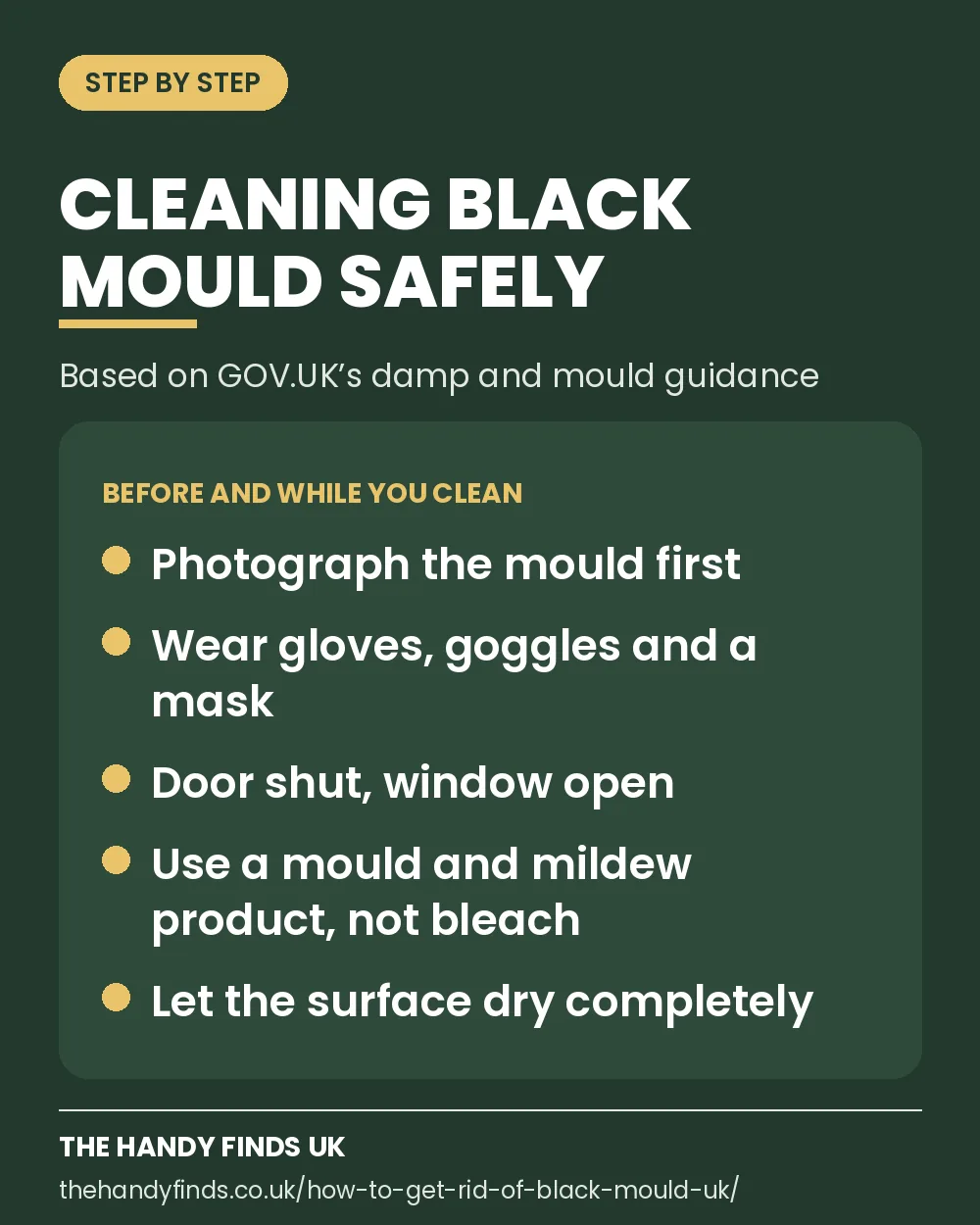
- Photograph the mould first and, if you can, draw lightly around its edge. GOV.UK suggests this to help identify the cause, and it's useful evidence if you rent.
- Protect yourself: gloves, goggles and a mask, as GOV.UK recommends.
- Close the door and open the window. GOV.UK says to keep doors shut so spores don't spread, and windows open during and after cleaning.
- Use a mould and mildew product, such as HG Mould Remover, following the instructions on the label. Test it on a hidden patch first if the surface is coloured. GOV.UK says to use these products in preference to bleach, for health and safety reasons. Never mix cleaning products.
- Wipe it off with a damp cloth, then let the surface dry completely.
- Bag up and bin the cloth or sponge, or wash it hot straight away, and wash your clothes afterwards.
- Soft, absorbent things (carpets, soft furnishings, ceiling tiles) may have to be thrown away if they're mouldy, GOV.UK says, because it can be impossible to clean them fully.
Don't brush or vacuum dry mould: that spreads spores. And don't paint straight over it. Anti-mould paint can help on a bathroom ceiling after you've cleaned it and fixed the moisture, but on its own it just hides the problem for a while.
How to get rid of black mould on silicone (shower, bath and window seals)
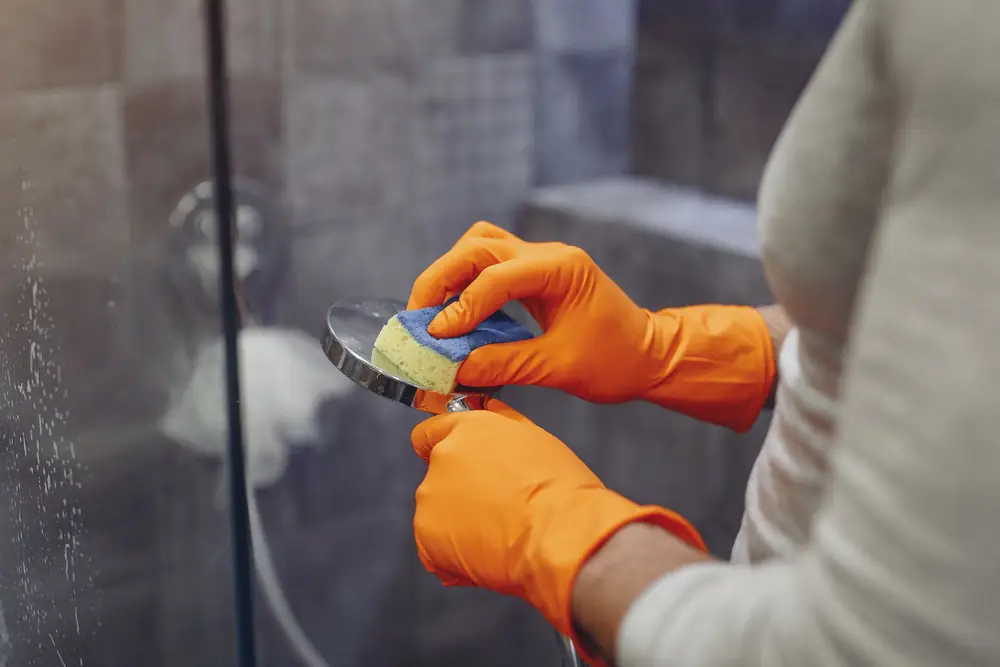
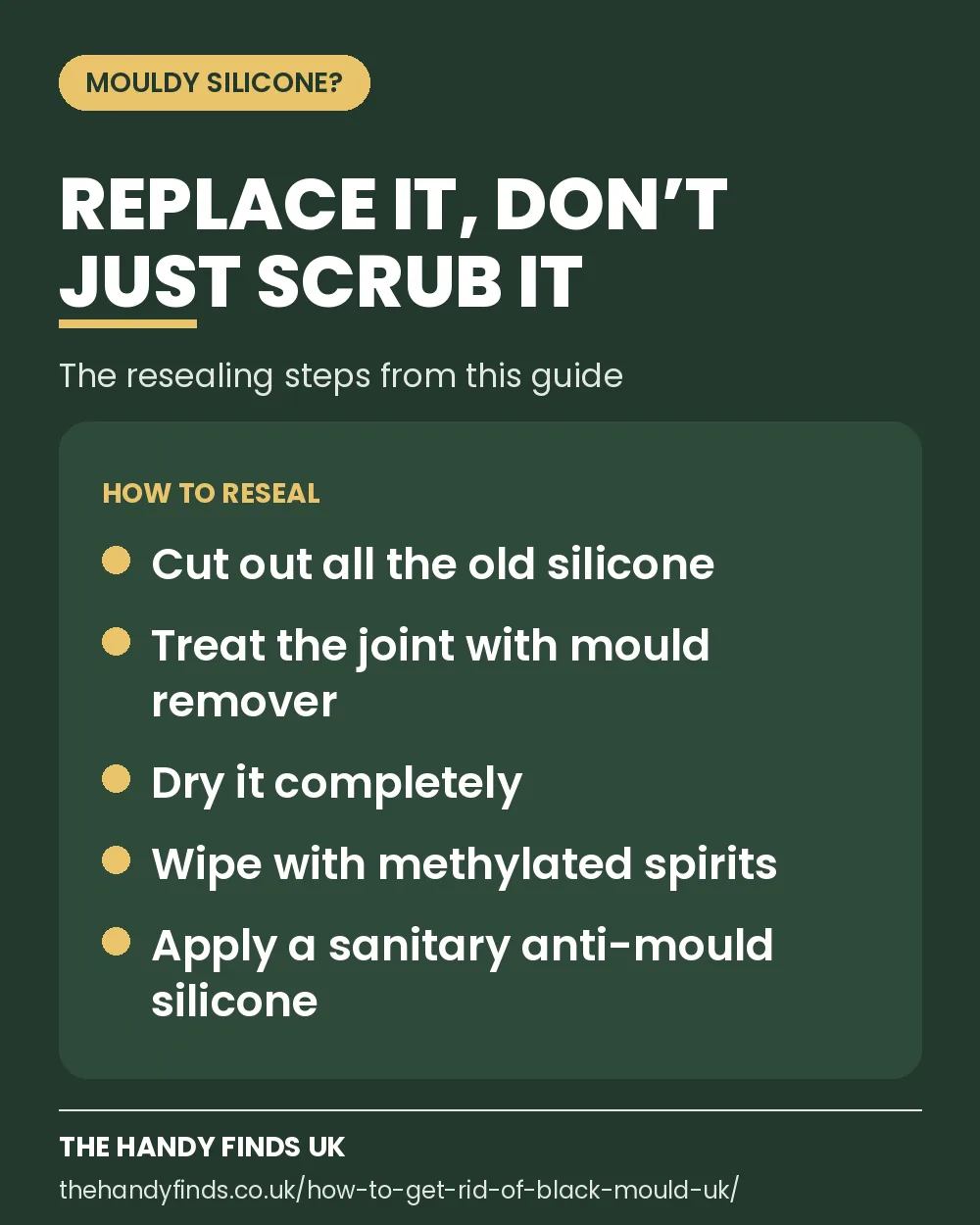
Mould on silicone sealant is stubborn because it grows into the soft sealant rather than just sitting on top. A mould spray will often lighten it, and that's worth trying first: spray, leave for the time on the label, rinse and dry. If black spots are still visible underneath the surface, cleaning won't shift them. The lasting fix is to replace the sealant, which is a cheap, half-day DIY job:
- Cut out all the old silicone with a sharp blade or sealant removal tool, then use a sealant remover to lift the residue. New silicone doesn't bond well to old silicone, so get every bit out. On plastic or acrylic trays and baths, use a plastic scraper to avoid scratches.
- Treat the joint with mould remover, rinse and wipe it down.
- Dry it completely. This is the step most people skip. Silicone won't stick to a damp joint, and moisture trapped behind it feeds new mould. Leave it for hours, or overnight with the bathroom fan or a dehumidifier running.
- Wipe the joint with methylated spirits to remove soap residue and grease.
- Apply a sanitary (anti-mould) silicone in one steady bead and smooth it with a profiling tool. Masking tape either side gives a neat line.
- Leave it to cure for the time on the tube (often around 24 hours) before using the shower.
Experienced DIYers on r/DIYUK add two tips: fill the bath with water before sealing so the joint doesn't stretch when it's used, and check that a shower tray isn't moving, because a tray that flexes will split new sealant again. If the tray moves, or there's water damage under it, get it fixed before resealing.
How to get rid of black mould in a bedroom
Bedrooms are the worst room for mould in many UK homes. Two people breathe out a lot of moisture overnight, the door is often shut and the heating goes off, so the walls and ceiling get cold. Mould tends to show up on the outside wall behind the bed or wardrobe, around the window reveal and in the corners of the ceiling.
Clean it as above, then tackle the cause: leave the trickle vents open, keep a little background heat, pull furniture a few centimetres away from outside walls, and don't dry washing in the bedroom. Our dedicated guide on how to stop condensation in a bedroom goes through each fix, and if you need a quiet machine for the room, see our best dehumidifiers for a bedroom or small flat.
Why does black mould keep coming back?
Because cleaning removes the mould, not the moisture. GOV.UK is clear that simply removing surface mould will not stop damp and mould reappearing. Look for the cause:
| Where the mould is | Likely cause | Fix to try |
|---|---|---|
| Bathroom ceiling and sealant | Shower steam, weak or unused extractor fan | Run the fan during and for 15+ minutes after showers; clean the grille; squeegee the walls |
| Bedroom corners and behind furniture | Cold outside walls, breath moisture, no air movement | Gap behind furniture, trickle vents open, low background heat, dehumidifier |
| Window frames and sills | Condensation left sitting every morning | Clear the glass each morning with a window vac; see our condensation fixes |
| Whole house on washing days | Laundry drying indoors | Dry in one room with a dehumidifier; see the cheapest way to dry clothes indoors |
| Bedroom ceiling near the eaves | Missing or patchy loft insulation | Check and top up the loft insulation |
| Low on a wall, or after rain | Rising or penetrating damp, or a leak | Get a surveyor or builder to check; mould spray won't fix it |
A hygrometer helps you tell which you're dealing with. If a room sits at 60–65% humidity or more for long periods in winter, condensation is the likely cause. Aim for about 50–55% with a dehumidifier. At the October 2026 cap of 26.32p per kWh, a 136W compressor model costs about 3.6p an hour, so eight hours overnight is 0.136 × 8 = 1.088kWh, or about 29p.
If you can smell damp but can't see where it's coming from, our guide to a damp smell in the house explains how to track down a hidden source. Mould on clothes or a black washing machine seal? See how to get mould off clothes and a washing machine seal.
If you rent: mould is usually your landlord's job to fix
GOV.UK's guidance for landlords in England says damp and mould should be tackled promptly, that landlords are responsible for addressing it whatever the type of damp, and that it is "totally unreasonable" to blame it on tenants' lifestyle choices such as cooking, bathing or drying laundry. It also says medical evidence is not needed before a landlord acts.
- Report it in writing (email is fine) with dated photos, and keep a copy.
- Say what you've already tried: ventilating, heating, clearing condensation.
- Ask for an inspection of the extractor fans, trickle vents, insulation and any leaks.
- If nothing happens, contact your council's private housing or environmental health team, or Shelter for advice.
In England, social landlords also have strict timescales to investigate and fix damp and mould hazards under Awaab's Law, in force since 27 October 2025. Rules differ in Scotland, Wales and Northern Ireland, so check Shelter Scotland, Shelter Cymru or Housing Advice NI for your area.
Handy products for black mould
How we chose: We based the cleaning and safety advice on GOV.UK's damp and mould guidance the resealing steps on UK tradespeople's published guides and common advice in r/DIYUK, and running costs on Ofgem's October to December 2026 price cap. For the products, we used well-reviewed items from our condensation and dehumidifier guides and re-checked each listing on 29 October 2026. These products have not been tested hands-on; this is a research-based roundup. How the research works.
Mould kit compared
| Pick | Type | What it does | Power | Good for | Where to buy |
|---|---|---|---|---|---|
| HG Mould Remover SprayBest mould remover | Mould and mildew spray | Removes black mould stains | None | Walls, ceilings, tiles, sealant | Check price |
| TempPro TP50 hygrometerBest for finding the cause | Digital hygrometer | Shows humidity and temperature | 1 × AAA battery (included) | Bedrooms, bathrooms, checking a dehumidifier works | Check price |
| Meaco Arete Two 10LBest dehumidifier for one mouldy room | Compressor dehumidifier | Pulls water out of the air into a tank | 136W at 20°C/60% (Meaco) | Flats, single rooms, bedrooms | Meaco Amazon |
| UniBond AERO 360Best for wardrobes and cupboards | Non-electric moisture absorber | Crystals soak up moisture into a tray | None | Wardrobes, cupboards, box rooms | Check price |
Specs are from manufacturer listings as of 29 October 2026; claimed figures (running costs, runtimes) are the maker’s, not ours. Check the retailer’s page for the current price and exact variant before you buy.
HG Mould Remover Spray, 500ml
Best for: Cleaning black mould off painted walls, tiles, grout, window seals and silicone
- Type
- Mould and mildew spray
- What it does
- Removes black mould stains
- Power
- None
- Good for
- Walls, ceilings, tiles, sealant
HG's mould spray is one of the best-selling mould removers on Amazon UK. HG says it removes mould and mildew from plastered walls, tiles, grout, silicone seals and windows, and that it has a bleaching effect, so test it somewhere hidden first. It's sold and shipped by Amazon.
Owners say it works fast with little or no scrubbing. The smell is strong, so ventilate, wear gloves and eye protection, keep it off fabrics and never mix it with other cleaning products. It cleans the surface; on silicone, mould that has grown into the sealant often stains it permanently, which is when resealing is the real fix.
What owners and reviewers like
- Fast on black mould with little scrubbing
- Works on walls, seals, grout and tiles
- Sold by Amazon
Watch-outs
- Strong smell; ventilate well
- Bleaching effect: test first
- Won't fix mould deep in old silicone
Check current price on Amazon Affiliate link · opens Amazon.co.uk
TempPro (formerly ThermoPro) TP50 Digital Thermo-Hygrometer
Best for: Checking whether a room's humidity is high enough to grow mould
- Type
- Digital hygrometer
- What it does
- Shows humidity and temperature
- Power
- 1 × AAA battery (included)
- Good for
- Bedrooms, bathrooms, checking a dehumidifier works
Mould needs moisture, so the cheapest diagnostic tool is a hygrometer. The TP50 shows temperature and relative humidity, records highs and lows and has a simple dry, comfortable or wet face. ThermoPro has rebranded as TempPro, so you may see either name. It's sold by TempPro UK and shipped by Amazon.
As a rough guide, a room that sits above about 60–65% for long periods in winter is likely to grow mould on its coldest surfaces. If yours does, the fixes below (ventilation, steady heat, a dehumidifier) matter more than any spray.
What owners and reviewers like
- Cheap way to measure the problem
- Min/max memory
- Shelf or magnet mounting
Watch-outs
- Occasional early failures
- No app or alerts on this model
Check current price on Amazon Affiliate link · opens Amazon.co.uk
MeacoDry Arete Two 10L Dehumidifier & Air Purifier
Best for: Keeping a bedroom or small flat below the humidity mould needs
- Type
- Compressor dehumidifier
- What it does
- Pulls water out of the air into a tank
- Power
- 136W at 20°C/60% (Meaco)
- Good for
- Flats, single rooms, bedrooms
A dehumidifier is the most effective single step when ventilation and heating aren't enough. Meaco lists the Arete Two 10L at 136W at 20°C/60%, which is about 3.6p an hour at 26.32p per kWh (0.136 × 26.32), or about 29p for eight hours. It has a humidistat, so it idles once the room reaches your target, and a night mode Meaco describes as 35dB on the low fan speed.
Extraction is modest (4.19 litres a day at 20°C/60%, Meaco says), so it suits a flat or one problem room. For a whole damp house, see the 20L models in our dehumidifier guide. In stock at Meaco and on Amazon (sold by Meaco UK) when we checked on 29 October 2026.
What owners and reviewers like
- Low running cost
- Humidistat and night mode
- 5-year warranty (Meaco)
Watch-outs
- Modest extraction for a big, damp house
- Small 2.5L tank
Check price at Meaco Also on Amazon Affiliate links · open meaco.com (via Awin) or Amazon.co.uk
UniBond AERO 360° Moisture Absorber, device with 1 refill tab (450g)
Best for: Stopping musty smells and mould spots in wardrobes, cupboards and under-stairs spaces
- Type
- Non-electric moisture absorber
- What it does
- Crystals soak up moisture into a tray
- Power
- None
- Good for
- Wardrobes, cupboards, box rooms
Mould often starts inside wardrobes on outside walls, where clothes are packed against a cold surface. A moisture trap like the UniBond AERO 360 needs no power and draws a little water out of the air into a tray. UniBond says it suits spaces up to 20m² and that a refill tab lasts up to three months, depending on how damp the space is. It's sold by Amazon, as are the 4-pack of refill tabs.
Be realistic: it absorbs far less than an electric dehumidifier, so it's a top-up for a small enclosed space, not a cure for a damp room. Leave a gap between the wardrobe and the wall as well.
What owners and reviewers like
- No power, no noise
- Good for enclosed spaces
- Sold by Amazon
Watch-outs
- Absorbs far less than a dehumidifier
- Refills are an ongoing cost
Check current price on Amazon Affiliate link · opens Amazon.co.uk
We use MailerLite to send emails. See our privacy policy.
FAQs
What kills black mould on walls?
A mould and mildew cleaning product, used as the label says. GOV.UK recommends these in preference to bleach for health and safety reasons. Wear gloves, goggles and a mask, keep the door shut and the window open, and let the surface dry fully afterwards.
Should I use bleach on black mould?
GOV.UK's damp and mould guidance says mould and mildew products should be used in preference to bleach, for health and safety reasons. Never mix bleach with other cleaning products.
How do I get rid of black mould on silicone permanently?
Spray it with mould remover first. If the black spots are inside the sealant, cut all the old silicone out, treat and fully dry the joint, wipe it with methylated spirits and reseal with a sanitary anti-mould silicone. Then improve ventilation so the new seal stays dry.
Why does mould keep coming back after cleaning?
Because the moisture that caused it is still there. Cleaning removes the mould, not the cause. Improve ventilation, keep rooms steadily heated, leave gaps behind furniture and use a dehumidifier if humidity stays above about 60–65%.
Is black mould in a bedroom dangerous?
GOV.UK says damp and mould mainly affect the airways and lungs, and can cause or worsen asthma and allergies. Children, older people, pregnant women and anyone with a lung condition or weakened immune system are at greater risk. Clean small patches promptly, fix the cause and speak to a GP about any symptoms.
Can I paint over black mould?
Not without cleaning it and fixing the cause first. Paint, including anti-mould paint, only hides mould for a while if the wall stays damp.
Is my landlord responsible for mould?
In most cases, yes. GOV.UK's guidance for landlords in England says they're responsible for addressing damp and mould, should act promptly and shouldn't blame tenants' everyday activities. Report it in writing with photos.
Do you get commission?
Yes. If you buy through our links, Amazon or Meaco (via Awin) may pay us a small commission at no extra cost to you. It doesn't affect which products we include. See our Affiliate Disclosure.
- GOV.UK: understanding and addressing the health risks of damp and mould in the home
- Shelter England: damp and mould in rented homes
- GOV.UK: Awaab's Law guidance for tenants in social housing
- Energy Saving Trust: how to get rid of damp
- Gosforth Handyman: how to re-silicone a mouldy shower
- r/DIYUK: resealing shower tray (discussion)
- Ofgem: energy price cap unit rates, 1 October to 31 December 2026
- Meaco: MeacoDry Arete Two 10L specifications
Prices change constantly, so we don’t list them here. Always check the current price, seller and delivery details on the retailer’s site before buying. If anything on this page looks wrong or out of date, let me know.