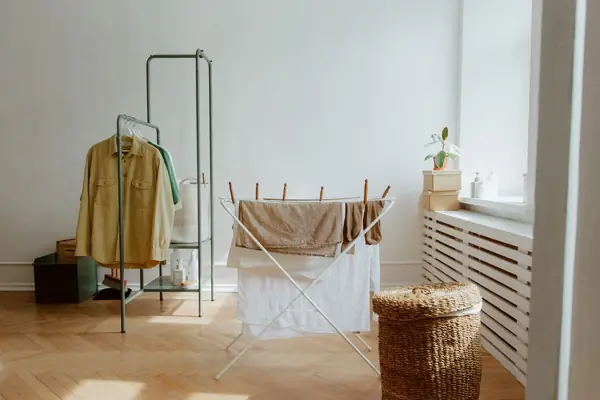
The cheapest way to dry clothes indoors in the UK: every method costed
An ordinary airer is free but slow and steams up the house. Here's what every indoor drying method costs per load at the October 2026 price cap, with the sums shown, and the cheap setup that dries washing without causing condensation.
Drying washing indoors is a winter fact of life in most UK homes. The question is how to do it cheaply without wet windows, musty rooms and black mould. A full load of washing holds litres of water, and every drop ends up in the air of your home unless something removes it.
The short answer: an ordinary airer is free to run but it's the method most likely to cause damp. A compressor dehumidifier next to an airer is usually the cheapest way to get washing properly dry indoors, at roughly 20–25p for a six-hour session at the price cap, and it takes the water out of the room instead of putting it on your windows. A heated clothes airer costs a little more per load and still adds moisture to the room. A heat pump tumble dryer is cheap per load too, but it costs far more to buy.
Below we compare every method with the working shown, explain when each one makes sense, and cover the setup tips that cut drying time. If you already know you want a dehumidifier for laundry, go straight to our best dehumidifier for drying clothes guide.
Who this guide is for: Renters and homeowners with no tumble dryer (or one that's too expensive to run), anyone fed up with damp washing on radiators, and anyone whose windows run wet on washing days. If you have black mould already, read our guide to getting rid of black mould too.
The cheapest ways to dry clothes indoors, ranked
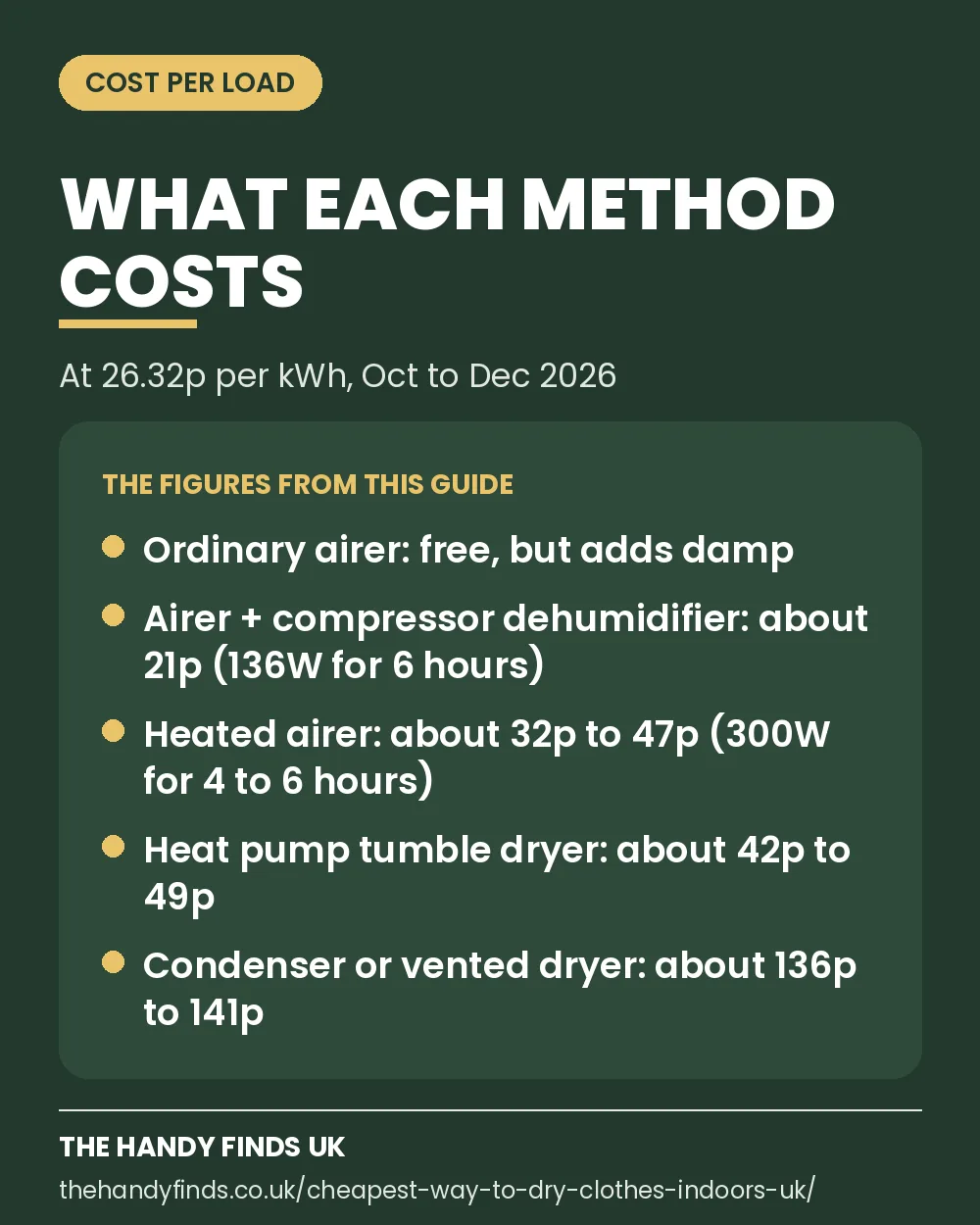
Here's what each method costs per load at Ofgem's October to December 2026 cap of 26.32p per kWh. The sum is always watts ÷ 1,000 × hours × 26.32p. Your own tariff may differ, so swap in your rate from your bill.
| Method | Example power and time | Working (at 26.32p/kWh) | Cost per load | Adds damp? |
|---|---|---|---|---|
| Ordinary airer, window ajar | No electricity | – | Free (but slowest) | Yes, unless ventilated |
| Airer + compressor dehumidifier | 136W for 6 hours (Meaco Arete Two 10L) | 0.136 × 6 = 0.816kWh × 26.32p | about 21p | No, it removes it |
| Airer + compressor dehumidifier | 149W for 6 hours (MeacoDry ABC 12L) | 0.149 × 6 = 0.894kWh × 26.32p | about 24p | No, it removes it |
| Heated airer | 300W for 4 hours | 0.3 × 4 = 1.2kWh × 26.32p | about 32p | Yes |
| Heated airer | 300W for 6 hours | 0.3 × 6 = 1.8kWh × 26.32p | about 47p | Yes |
| Heated airer + dehumidifier together | 300W + 136W for 4 hours | 0.436 × 4 = 1.744kWh × 26.32p | about 46p | No |
| Desiccant dehumidifier (cold room) | 580W for 4 hours (EcoAir DD1, high) | 0.58 × 4 = 2.32kWh × 26.32p | about 61p | No |
| Heat pump tumble dryer | Label figures, full load | From the energy label | about 42p–49p | No |
| Condenser or vented tumble dryer | Label figures, full load | From the energy label | about 136p–141p | No (vented must vent outside) |
The tumble dryer figures are the per-load costs from the energy labels in our tumble dryer guide (for example, the Hoover heat pump model at about 42p and the Candy vented model at about 141p a full load). Dehumidifier and airer times are examples: real drying times depend on the load, the room temperature and how well the washing was spun.
Which?'s own tests point the same way: it found heated airers average about 7p an hour to run and take four to five hours for a small cotton load, and that a dehumidifier is the method that also lowers the risk of damp and mould. See Which?'s guide to the cheapest way to dry clothes indoors.
What it adds up to over a winter
If you dry three loads a week (156 a year), the gap between methods grows quickly. Using the examples above:
- Airer + Arete Two 10L for 6 hours: 21.48p × 156 = about £34 a year.
- Heated airer for 6 hours: 47.38p × 156 = about £74 a year.
- Heat pump tumble dryer at 42p a load: 42p × 156 = about £66 a year.
- Vented tumble dryer at 141p a load: 141p × 156 = about £220 a year.
These are running costs only. A heated airer costs much less to buy than a dehumidifier, and a heat pump tumble dryer costs far more than either, so if you only dry the odd load, a heated airer can still be the cheaper buy overall. If you dry most days, or the house is already damp, a dehumidifier usually wins on both cost and damp.
Heated airer vs dehumidifier: which should you buy?
This is the most common question, and the honest answer is that they do different jobs:
- A heated airer warms the washing so the water evaporates faster. All of that water goes into the room. It's cheap to buy, simple and quiet.
- A dehumidifier pulls water out of the air and into a tank, so the washing dries faster and the room stays dry. It costs more to buy but less to run, and it helps with condensation and mould every day, not just on washing days.
If you can only have one and your home gets condensation, choose the dehumidifier. If your home is dry and you mainly want faster drying in a ventilated room, a heated airer is fine. Many people end up with both: the airer under a cover with a dehumidifier in the same small room is the fastest setup, though it costs more per load than a dehumidifier and plain airer.
Is it OK to dry clothes on radiators?
It feels free, because the heating is on anyway, but it isn't really. Clothes draped over a radiator stop the heat getting into the room, and all the water still ends up in the air. Notting Hill Genesis's damp and mould advice says to try not to use radiators to dry clothes because it stops them working properly, and Shelter's advice is to dry outside or in a tumble dryer where you can.
If the radiator is your only option, dry a few small items at a time, keep the room's door shut and open the window a little, or run a dehumidifier in the same room. Never drape washing over an electric heater, storage heater or fan heater: covering a heater is a fire risk.
How to dry washing indoors without causing damp

- Spin it harder first. An extra spin cycle at the washing machine's top speed takes out water for a fraction of the cost of drying it out of the air.
- Dry in one small room with the door shut. Spreading wet washing around the house spreads the moisture too.
- Run a dehumidifier in that room, on its laundry mode if it has one, with the window shut. Or, without a dehumidifier, open the window a little and keep the door closed.
- Add a fan. Moving air speeds drying a lot. A desk fan rated around 40W (check yours) costs 0.04 × 6 = 0.24kWh, or about 6p, for six hours.
- Space items out in single layers with gaps between them. Hang shirts on hangers.
- Don't dry in the bedroom, especially overnight. See our guide to stopping condensation in a bedroom.
- Clear any condensation on the windows afterwards with a window vac rather than a cloth you then dry on the radiator.
Shelter's guidance for renters is the same: dry outside or in a tumble dryer if you can, and if you have to dry inside, open windows or use a dehumidifier in the room. If you rent and have nowhere else to dry washing, tell your landlord in writing, especially if damp or mould is appearing.
Does drying clothes indoors cause mould?
It can. GOV.UK's damp and mould guidance lists drying laundry alongside showering and cooking as everyday activities that build up moisture in a home if it can't escape. Over time that moisture condenses on cold walls and windows, and mould grows where it sits. The fix isn't to stop drying washing; it's to remove the moisture as you go with ventilation or a dehumidifier.
If mould has already appeared, clean it with a mould and mildew product and deal with the cause. Our black mould guide explains how, and our condensation guide has 12 fixes for wet windows.
If something has already gone mouldy, our guide to getting mould off clothes and out of a washing machine seal covers rescuing it.
Handy kit for drying washing indoors
How we chose: We worked out running costs from each maker's published wattage and Ofgem's October to December 2026 price cap unit rate, and used the yearly energy figures on UK tumble dryer labels. The drying advice draws on the Energy Saving Trust, Shelter and Which?'s published drying tests. For the products, we picked well-reviewed models from our heated airer and dehumidifier guides and re-checked each listing on 29 October 2026. These products have not been tested hands-on; this is a research-based roundup. How the research works.
Drying kit compared
| Pick | Type | Power (maker) | Cost per hour* | Good for | Where to buy |
|---|---|---|---|---|---|
| Meaco Arete Two 10LCheapest to run with an airer | Compressor dehumidifier | 136W at 20°C/60% (152W listed) | 3.6p–4.0p | Flats, 1–2 bed homes, single rooms | Meaco Amazon |
| MeacoDry ABC 12LBudget dehumidifier for laundry | Compressor dehumidifier | 149W at 20°C/60% (165W listed) | 3.9p–4.3p | Small homes, laundry and condensation | Meaco Amazon |
| Dry:Soon Deluxe 3-TierBest heated airer for full loads | Heated airer (3-tier tower) | 300W | 7.9p | Full family loads | Check price |
| BLACK+DECKER 3-Tier with CoverBest heated airer with a cover included | Heated airer (3-tier tower) | 300W | 7.9p | Full loads in one room | Check price |
| Minky SureDRI WingedBest for small homes | Heated airer (winged) | Check the listing | About 5–8p (200–300W) | Smaller loads, tight storage | Check price |
| EcoAir DD1 Simple MK3Best for a cold room | Desiccant dehumidifier | 300W low / 580W high | 7.9p–15.3p | Cold rooms below about 15°C | Check price |
Specs are from manufacturer listings as of 29 October 2026; claimed figures (running costs, runtimes) are the maker’s, not ours. Check the retailer’s page for the current price and exact variant before you buy.
MeacoDry Arete Two 10L Dehumidifier & Air Purifier
Best for: Drying washing on an ordinary airer in a flat or small home for pennies an hour
- Type
- Compressor dehumidifier
- Power (maker)
- 136W at 20°C/60% (152W listed)
- Cost per hour*
- 3.6p–4.0p
- Good for
- Flats, 1–2 bed homes, single rooms
The Arete Two is Meaco's smart compressor dehumidifier for smaller homes. Meaco lists 136W at 20°C and 60% humidity, which works out at 0.136 × 26.32 = about 3.6p an hour. It has a laundry mode with an adjustable timer, a louvre you can point at the airer and app control. Meaco says it dries laundry faster and cheaper than any of its other dehumidifiers, and it describes the night mode as 35dB on the low fan speed.
Extraction is modest (4.19 litres a day at 20°C/60%, Meaco says), so it suits a flat or one room rather than a damp family house. It was in stock at Meaco when we checked on 29 October 2026, and Amazon UK sells it through Meaco (UK). For more laundry picks, including bigger 20L models, see our dehumidifier for drying clothes guide.
What owners and reviewers like
- Very low running cost
- Laundry timer and adjustable louvre
- Takes the moisture out of the room
- 5-year warranty (Meaco)
Watch-outs
- Modest extraction for a big, damp house
- Small 2.5L tank
- Costs more to buy than a heated airer
Check price at Meaco Also on Amazon Affiliate links · open meaco.com (via Awin) or Amazon.co.uk
MeacoDry ABC 12L Dehumidifier
Best for: A cheaper Meaco compressor model for small loads and a damp room
- Type
- Compressor dehumidifier
- Power (maker)
- 149W at 20°C/60% (165W listed)
- Cost per hour*
- 3.9p–4.3p
- Good for
- Small homes, laundry and condensation
The ABC 12L is Meaco's simpler, cheaper range. Meaco lists 149W at 20°C/60%, so about 0.149 × 26.32 = 3.9p an hour, and a laundry mode that runs at full speed for six hours and then switches off. A six-hour laundry session is about 0.894kWh, or roughly 24p. It has Quiet Mark accreditation and an off-timer.
You give up the HEPA filter, castors and the longer warranty of the Arete range (it's 2 years as standard), and airflow is lower, so big family loads take longer. The Amazon listing has size and colour options, so check that 12L is selected. Amazon UK sells it through Meaco (UK).
What owners and reviewers like
- Low running cost for the price
- Laundry mode switches itself off
- Quiet Mark accredited
Watch-outs
- No castors or HEPA filter
- 2-year standard warranty
- Slower on big loads
Check price at Meaco Also on Amazon Affiliate links · open meaco.com (via Awin) or Amazon.co.uk
Dry:Soon Deluxe 3-Tier Heated Clothes Airer with Timer
Best for: Families who dry full loads several times a week and want a timer
- Type
- Heated airer (3-tier tower)
- Power (maker)
- 300W
- Cost per hour*
- 7.9p
- Good for
- Full family loads
Lakeland's Dry:Soon range is the best-known heated airer in the UK, and the Deluxe 3-tier adds a timer, so it switches off on its own. At 300W it costs 0.3 × 26.32 = 7.9p an hour, or about 47p if a load takes six hours. It has 21m of drying space and folds down to half height for smaller loads. On Amazon it's sold by Lakeland and shipped by Amazon.
Remember that a heated airer warms the washing; it doesn't remove the water from the room. In a small room with the door shut, pair it with a dehumidifier or open the window a little, or the moisture ends up on your windows. A cover (sold separately for this model) speeds things up. For four more airers, see our heated clothes airers guide.
What owners and reviewers like
- Built-in timer
- Big drying space in a small footprint
- Folds to half size
Watch-outs
- Adds moisture to the room
- Cover sold separately
- Costs the same per hour half-empty
Check current price on Amazon Affiliate link · opens Amazon.co.uk
BLACK+DECKER 3-Tier Heated Airer with Cover & Wheels (63091)
Best for: Anyone who wants a tiered heated airer with the cover in the box
- Type
- Heated airer (3-tier tower)
- Power (maker)
- 300W
- Cost per hour*
- 7.9p
- Good for
- Full loads in one room
This BLACK+DECKER tower has the same 300W power and 21m of drying space as the Dry:Soon, with a cover and wheels included. A cover traps the warm air around the washing, which is the single biggest thing you can do to speed up a heated airer. At the price cap it costs 7.9p an hour to run.
It's sold by The Benross Group (BLACK+DECKER's UK licensee) rather than by Amazon. As with any heated airer, run it in a room with a dehumidifier or a slightly open window so the moisture doesn't settle on cold walls.
What owners and reviewers like
- Cover and wheels included
- Same capacity as the Dry:Soon
- Easy to move between rooms
Watch-outs
- Sold by a third-party seller
- No timer listed
- Adds moisture to the room
Check current price on Amazon Affiliate link · opens Amazon.co.uk
Minky SureDRI Winged Heated Clothes Airer (12m)
Best for: Small flats where the airer has to fold flat after every use
- Type
- Heated airer (winged)
- Power (maker)
- Check the listing
- Cost per hour*
- About 5–8p (200–300W)
- Good for
- Smaller loads, tight storage
A winged airer folds flatter than a tower, which matters in a small flat. The Minky SureDRI gives 12m of heated drying space. Most heated airers draw 200 to 300W, which is 5.3p to 7.9p an hour at 26.32p per kWh; check the exact wattage on the listing before you buy. It's sold by Amazon.
Winged airers hold less than towers, so they suit smaller, more frequent loads. Spread items in single layers and leave gaps between them, and drape an old sheet over the top to keep the heat in.
What owners and reviewers like
- Folds flat for storage
- Sold by Amazon
- Light and easy to move
Watch-outs
- Less drying space than a tower
- Wattage not stated in our specs
- Adds moisture to the room
Check current price on Amazon Affiliate link · opens Amazon.co.uk
EcoAir DD1 Simple MK3 Desiccant Dehumidifier
Best for: Drying washing in an unheated utility room, conservatory or spare room
- Type
- Desiccant dehumidifier
- Power (maker)
- 300W low / 580W high
- Cost per hour*
- 7.9p–15.3p
- Good for
- Cold rooms below about 15°C
Compressor dehumidifiers slow down in cold rooms. A desiccant model like the EcoAir DD1 Simple keeps working (EcoAir says from 1°C) and blows out slightly warm, dry air, which helps washing dry. EcoAir lists 300W on low and 580W on high, so it costs 7.9p to 15.3p an hour at the price cap: four hours on high is 2.32kWh, or about 61p.
That makes it dearer to run than a compressor model in a heated room, but it's the right tool for a cold space. It's sold and shipped by Amazon; there were 7 left when we checked on 29 October 2026. See our desiccant dehumidifier guide for more cold-room options.
What owners and reviewers like
- Works in cold rooms
- Gently warms the air
- Simple rotary dial
- Sold by Amazon
Watch-outs
- Higher power use than compressor models
- No humidity readout or timer
- Some early-failure reports
Check current price on Amazon Affiliate link · opens Amazon.co.uk
We use MailerLite to send emails. See our privacy policy.
FAQs
What is the cheapest way to dry clothes indoors in the UK?
An ordinary airer is free, but it adds moisture to your home. The cheapest way that also keeps damp down is an airer with a compressor dehumidifier in a small closed room: a 136W model running for six hours uses 0.816kWh, about 21p at the October 2026 cap of 26.32p per kWh.
Is a heated airer cheaper than a tumble dryer?
Per hour, yes: a 300W heated airer costs about 7.9p an hour at 26.32p per kWh. Per load it depends on drying time. Six hours is about 47p, which is more than a heat pump tumble dryer's label figure of about 42–49p a full load, but much less than a condenser or vented dryer at about 136p–141p.
Is a dehumidifier or heated airer better for drying clothes?
A dehumidifier is better if your home gets condensation, because it removes the water from the room and costs less per hour. A heated airer is cheaper to buy and fine in a dry, ventilated room. Using both together is fastest.
How much does it cost to dry clothes with a dehumidifier?
Multiply the wattage by the hours and your unit rate. For example, a 149W dehumidifier on a six-hour laundry mode uses 0.149 × 6 = 0.894kWh, which is about 24p at 26.32p per kWh.
Should I put a cover on a heated airer?
Yes. A cover or an old sheet over the top traps the warm air around the washing and speeds up drying. It doesn't stop the moisture reaching the room, so still ventilate or run a dehumidifier.
Is it bad to dry clothes on radiators?
It's best avoided. It blocks heat from the room and puts all the water into the air, which leads to condensation. Never drape washing over an electric, storage or fan heater: covering a heater is a fire risk.
How can I dry clothes indoors quickly without a dryer?
Spin the washing on the fastest setting, hang it in single layers in one small room, run a dehumidifier on its laundry setting and point a fan at the airer. A cover over a heated airer also speeds things up.
Do you get commission?
Yes. If you buy through our links, Amazon or Meaco (via Awin) may pay us a small commission at no extra cost to you. It doesn't affect which products we include. See our Affiliate Disclosure.
- Ofgem: energy price cap unit rates, 1 October to 31 December 2026
- Which?: the best and cheapest way to dry clothes indoors
- Which?: are heated airers worth it?
- Shelter England: how to deal with condensation
- Energy Saving Trust: how to get rid of damp
- Notting Hill Genesis: damp and mould advice
- GOV.UK: understanding and addressing the health risks of damp and mould in the home
- Meaco: MeacoDry Arete Two 10L specifications
- Meaco: MeacoDry ABC 12L specifications
Prices change constantly, so we don’t list them here. Always check the current price, seller and delivery details on the retailer’s site before buying. If anything on this page looks wrong or out of date, let me know.