How to get mould off clothes and out of a washing machine seal (and stop it coming back)
Mould on clothes and on a washing machine's rubber seal usually come from the same thing: damp that never quite dries. Here's how to rescue mouldy clothes, clean the seal the way the manufacturers recommend, and stop both coming back.
Pull a shirt from the back of the wardrobe and find grey-green spots, or open the washing machine and see a black ring in the folds of the rubber seal: both are mould, and both are common in UK homes from autumn onwards, when washing dries slowly indoors and wardrobes sit against cold outside walls.
The good news is that most mould on washable clothes will come out with a hot wash and an oxygen-based stain remover, and most seal mould can be cleaned or prevented with a monthly hot maintenance wash. The fix that lasts is drying: clothes put away bone dry, a washing machine left open to air, and a home where damp has somewhere to go.
Below: how to treat mouldy clothes step by step, when to give up on an item, how to clean a washing machine seal, why it keeps going black, and how to stop wardrobe mould. If the mould is on your walls too, see our guide on how to get rid of black mould.
Who this guide is for: Anyone with mould spots or a musty smell on clothes, towels or bedding, a black or smelly washing machine door seal, or a wardrobe that smells damp. If anyone at home has asthma, a lung condition or a weakened immune system, GOV.UK's guidance is that they're at greater risk from damp and mould, so keep them away while you clean.
How to get mould out of clothes, step by step
- Check the care label before you do anything. It tells you the hottest wash the fabric can take, and whether it can be bleached or must be dry-cleaned.
- Take it outside and gently brush off any loose, fuzzy mould there, not indoors, so spores don't spread around the house. Wear gloves and, if you're sensitive to mould, a mask.
- Wash it on its own at the hottest temperature the care label allows, with your usual detergent plus an oxygen-based stain remover: a whites formula for whites, a colour-safe one for colours. Follow the pack for dosing and pre-soaking.
- Check before you dry it. If marks remain, repeat the soak and wash. Don't tumble-dry or iron it while it's still stained, because heat can set stains.
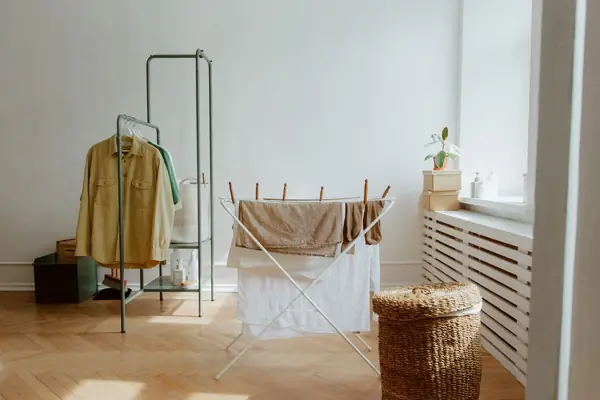
- Dry it fully and fast: outside on a breezy day if you can, or indoors with airflow (see our cheapest way to dry clothes indoors).
Never mix bleach with other cleaning products, and don't use chlorine bleach on coloured clothes, wool or silk. Dry-clean-only clothes, leather, suede and anything valuable are best taken to a dry cleaner, and tell them it's mould.
When to throw mouldy clothes away
GOV.UK's damp and mould guidance says soft, absorbent things that have gone mouldy, such as carpets and soft furnishings, may need to be thrown away, because it can be impossible to clean them fully. The same applies to clothes. If an item is still stained or smells musty after two careful washes, or the mould has rotted the fabric, it's usually time to let it go.
Bag it up before you carry it through the house. Then find out why it went mouldy, or the next item will follow.
How to clean a mouldy washing machine seal
AEG says dark or black spots on a washing machine's rubber seal are almost always mould or mildew. The causes are moisture sitting in the seal's folds, too much detergent, and lots of washes at 40°C or below, which leave a greasy residue for mould to feed on. The makers' steps are broadly the same:
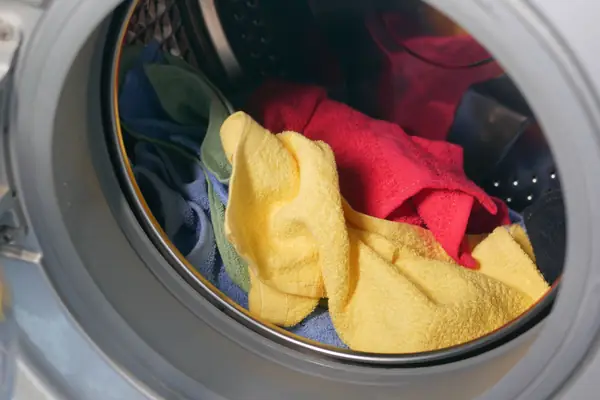
- Run an empty hot maintenance wash. AEG suggests a 90°C or 95°C cycle once a month (more often if you use the machine a lot). Beko suggests a hot cotton cycle at 70°C or above every one to three months, and Hoover recommends using a washing machine cleaner once a month. Use your machine's own drum-clean programme if it has one.
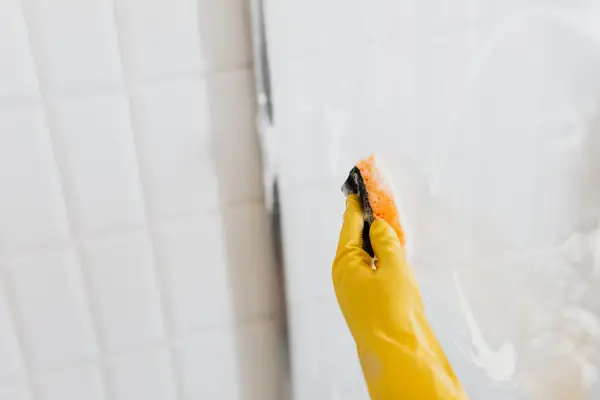
- Clean the seal itself. Pull the folds back gently and wipe them with a damp cloth and soapy water (Beko's advice), or a mould gel used as directed. A soft toothbrush helps in the creases. Don't pull the seal away from the metal drum.
- Dry it. Wipe the seal and the inside of the door with a dry cloth.
- Clean the detergent drawer and the filter while you're at it. Samsung recommends cleaning the drain pump filter regularly, at least five or six times a year.
If the black won't shift, the mould has grown into the rubber. AEG and Electrolux both say the seal may then need replacing, and Electrolux says its replacement seals should be fitted by a professional technician.
Why does the washing machine seal keep going black?
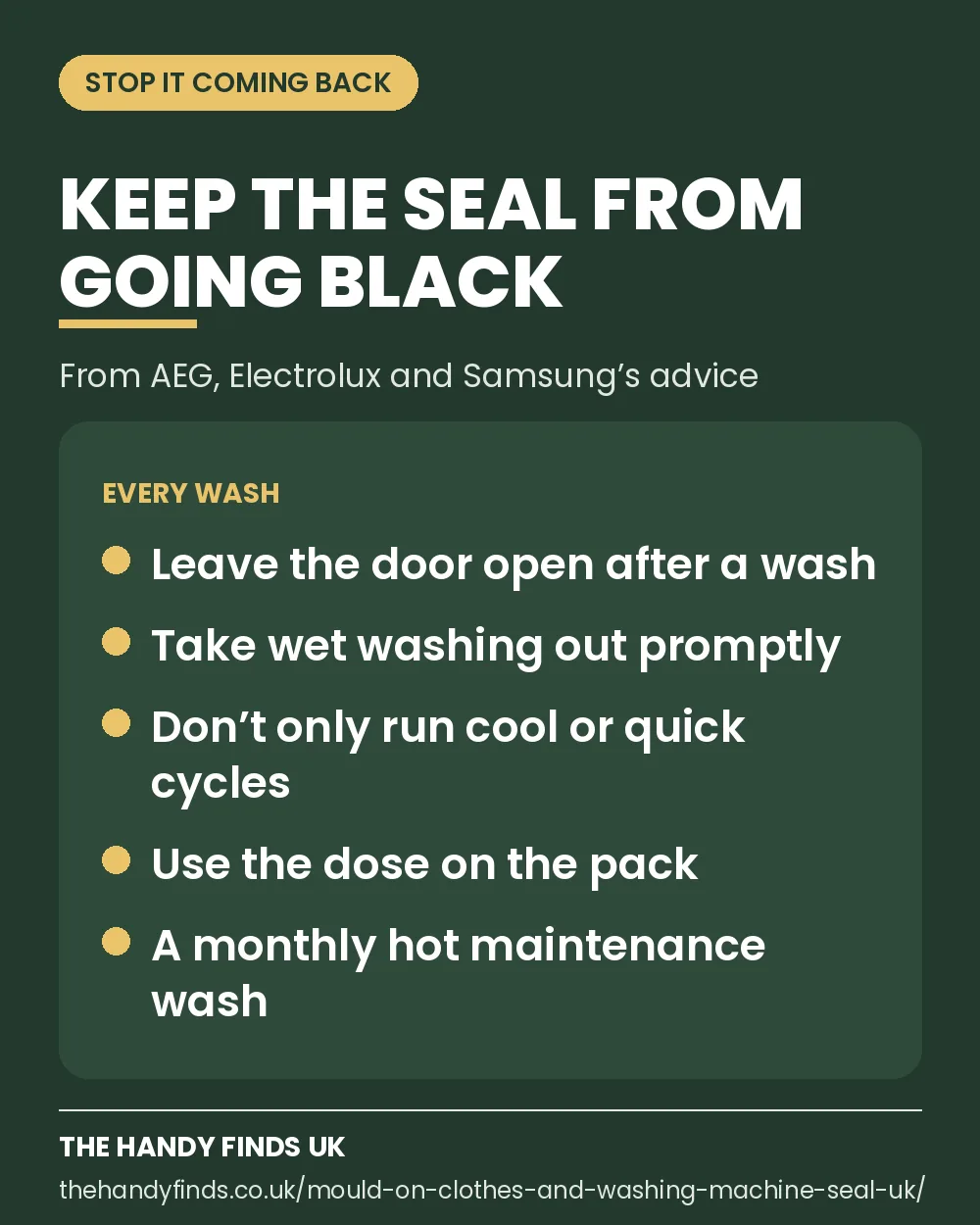
- The door is shut between washes. AEG, Electrolux and Samsung all say to leave the door (and Samsung adds the detergent drawer) open after a wash so the drum can dry.
- Wet washing is left in the drum. Take it out as soon as the cycle ends.
- Every wash is cool or quick. Electrolux says that if you only run cold or quick cycles you're more likely to get mould on the seal.
- Too much detergent. AEG lists over-dosing as a cause of residue on the seal. Use the dose on the pack for your load and water hardness.
- No regular maintenance wash. Put a monthly hot empty wash in your calendar.
If you're choosing a new machine, many now have a drum-clean programme and a reminder. See our best washing machines guide.
How to stop clothes going mouldy in the wardrobe
- Only put clothes away bone dry. Slightly damp clothes in a closed wardrobe are the most common cause.
- Leave a gap between the wardrobe and an outside wall. GOV.UK suggests leaving a gap between furniture and external walls so air can circulate.
- Don't pack it tight. Air needs to move between the clothes.
- Don't dry washing in the bedroom with the door shut. If you must dry indoors, use one room with the door closed and a window open or a dehumidifier running. Our dehumidifiers for drying clothes guide covers the machines.
- Put a moisture trap in the wardrobe and check how fast it fills. If it fills in days, the whole room is too damp.
A musty wardrobe is often a sign of a damp bedroom. Our guide on how to stop condensation in a bedroom covers the fixes, and if you can smell damp around the house, see damp smell in the house: causes and fixes.
Handy products for mouldy clothes and seals
How we chose: We based the seal-cleaning steps on the support pages of AEG, Electrolux, Hoover, Beko and Samsung UK, and the safety and when-to-bin advice on GOV.UK's damp and mould guidance. The clothes advice follows care-label basics and the instructions on each product. Every product was re-checked on Amazon UK on 29 October 2026. We haven't tested these products ourselves. These products have not been tested hands-on; this is a research-based roundup. How the research works.
Products compared
| Pick | Type | Use it for | Check first | Amazon |
|---|---|---|---|---|
| Dr. Beckmann Service-it Deep CleanBest washing machine cleaner | Washing machine cleaner (powder) | Monthly empty hot wash | Your machine's manual for its cleaning cycle | Check price |
| ACTIVE mould stain remover gelBest for a black seal | Mould stain gel | Rubber seals, grout, sealant | The directions on the bottle; test a small area | Check price |
| Vanish Gold Crystal WhiteBest for white clothes | Oxygen stain remover for whites | White washables | The care label and pack dosing | Check price |
| by Amazon Oxy Power (colours)Best for coloured clothes | Oxygen stain remover for colours | Coloured washables | Colourfastness on a hidden seam | Check price |
| UniBond AERO 360Best for a damp wardrobe | Non-electric moisture absorber | Wardrobes, cupboards, under-stairs | Empty the tray before it overflows | Check price |
Specs are from manufacturer listings as of 29 October 2026; claimed figures (running costs, runtimes) are the maker’s, not ours. Check the Amazon page for the current price and exact variant before you buy.
Dr. Beckmann Service-it Deep Clean Washing Machine Cleaner, 250g
Best for: A monthly hot maintenance wash to clear the residue mould feeds on
- Type
- Washing machine cleaner (powder)
- Use it for
- Monthly empty hot wash
- Check first
- Your machine's manual for its cleaning cycle
The manufacturers we checked all recommend a regular empty hot wash with a machine cleaner. Dr. Beckmann's Service-it Deep Clean is one of the best-known in the UK. Its listing says it removes 99.99% of bacteria, viruses and fungi that cause odours, and that its activated carbon absorbs dirt and residue left by low-temperature washes and over-dosing. It was sold by Amazon when we checked on 29 October 2026, with more than 24,000 ratings.
Follow the pack instructions and your machine's manual: some machines have their own drum-clean programme. A cleaner clears residue inside the drum and pipes. It won't remove mould already stained into the rubber seal, so treat that separately (see below).
What owners and reviewers like
- Made for a monthly maintenance wash
- Tackles low-temperature residue (maker)
- Sold by Amazon
Watch-outs
- Won't shift stains already in the seal
- Ongoing cost if used monthly
Check current price on Amazon Affiliate link · opens Amazon.co.uk
ACTIVE Mould Stain Remover Gel for washing machine seals, 207ml
Best for: Black spots in the folds of a front-loader's rubber door seal
- Type
- Mould stain gel
- Use it for
- Rubber seals, grout, sealant
- Check first
- The directions on the bottle; test a small area
A gel stays put on a vertical or curved seal instead of running off like a spray, which is why seal gels are popular. ACTIVE's listing says it's made for front-loader gaskets, fridge seals, grout and sealant, and that it removes the discolouration and black spots left by mould. It had more than 31,000 ratings when we checked, and was sold by ACTIVE and dispatched by Amazon.
Follow the directions on the bottle, wear gloves, ventilate the room and never mix it with other cleaning products. If the black has grown deep into the rubber, AEG and Electrolux both say the seal may need replacing, so treat a gel as the step before that.
What owners and reviewers like
- Clings to seals and grout
- Very widely reviewed
- Fragrance-free (listing)
Watch-outs
- Deep stains may not lift
- Third-party seller, dispatched by Amazon
Check current price on Amazon Affiliate link · opens Amazon.co.uk
Vanish Gold Crystal White Stain Remover Powder, 1.5kg
Best for: Mould spots on white shirts, towels and bedding
- Type
- Oxygen stain remover for whites
- Use it for
- White washables
- Check first
- The care label and pack dosing
For mould on whites, add an oxygen-based stain remover to a wash at the hottest temperature the care label allows. Vanish's listing says Crystal White is chlorine bleach-free with anti-greying protection and is safe on everyday white fabrics. It was sold by Amazon when we checked, with more than 16,000 ratings.
It's for whites only. Follow the pack for dosing and soaking, keep it off wool and silk, and check the item before it goes anywhere near a tumble dryer: heat can set any stain that's left.
What owners and reviewers like
- Chlorine bleach-free (listing)
- Works in the wash or as a soak
- Sold by Amazon
Watch-outs
- Whites only
- Not for wool or silk
Check current price on Amazon Affiliate link · opens Amazon.co.uk
by Amazon Oxy Power Stain Remover Powder for Colours, 1kg
Best for: Mould spots on coloured, colourfast everyday clothes
- Type
- Oxygen stain remover for colours
- Use it for
- Coloured washables
- Check first
- Colourfastness on a hidden seam
For coloured clothes, use a colour-safe oxygen stain remover rather than bleach. Amazon's own-brand Oxy Power uses active oxygen, is bleach-free and, according to its listing, is safe on everyday colours and whites but not delicates. It had more than 2,000 ratings when we checked, and was sold by Amazon.
Test it on an inside seam first, follow the pack dosing, and wash at the warmest temperature the care label allows.
What owners and reviewers like
- Colour-safe and bleach-free (listing)
- Good value own-brand
- Sold by Amazon
Watch-outs
- Not for delicates
- Old, deep stains may need more than one wash
Check current price on Amazon Affiliate link · opens Amazon.co.uk
UniBond AERO 360° Moisture Absorber, device with 1 refill tab (450g)
Best for: Wardrobes and cupboards where clothes go musty
- Type
- Non-electric moisture absorber
- Use it for
- Wardrobes, cupboards, under-stairs
- Check first
- Empty the tray before it overflows
If clothes go mouldy in the wardrobe, the air in there is too damp. A moisture trap like the UniBond AERO 360 needs no power and draws a little water out of the air into a tray. UniBond says it suits spaces up to 20m² and that a refill tab lasts up to three months, depending on how damp the space is. It was sold by Amazon when we checked, as are the 4-pack of refill tabs.
It absorbs far less than an electric dehumidifier, so pair it with the wardrobe fixes below. For how these compare with an electric machine, see our dehumidifier vs air purifier vs moisture trap guide.
What owners and reviewers like
- No power, no noise
- Made for enclosed spaces
- Sold by Amazon
Watch-outs
- Absorbs far less than a dehumidifier
- Refills are an ongoing cost
Check current price on Amazon Affiliate link · opens Amazon.co.uk
We use MailerLite to send emails. See our privacy policy.
FAQs
How do you get mould out of clothes?
Brush off loose mould outside, then wash the item on its own at the hottest temperature the care label allows with detergent and an oxygen-based stain remover (a whites formula for whites, colour-safe for colours). Check it before drying, repeat if needed, and dry it fully and quickly.
Can mouldy clothes be saved?
Usually, if they're washable and the mould is caught early. GOV.UK's guidance notes that absorbent materials can be impossible to clean fully, so if an item still smells musty or is stained after two careful washes, it's often best to throw it away.
Does washing at 60 degrees kill mould?
A hot wash with a stain remover is the usual approach, but only go as hot as the care label allows. Manufacturers recommend running the empty machine hotter still (AEG suggests 90°C or 95°C, Beko 70°C or above) to clean the drum.
How do I get black mould off my washing machine seal?
Run an empty hot maintenance wash with a washing machine cleaner, then wipe the folds of the seal with a damp cloth and soapy water or a mould gel used as directed, and dry it. If the black has grown into the rubber, AEG and Electrolux say the seal may need replacing.
Why does my washing machine seal go mouldy?
Moisture left in the seal's folds, too much detergent and lots of washes at 40°C or below, according to AEG. Leave the door open after washing, remove wet washing promptly, wipe the seal dry and run a monthly hot maintenance wash.
Should I leave the washing machine door open?
Yes. AEG, Electrolux and Samsung all recommend leaving the door open after a wash so the drum and seal can dry. Samsung also suggests leaving the detergent drawer open. Keep children and pets away from an open machine.
Do you get commission?
Yes. If you buy through our links, Amazon may pay us a small commission at no extra cost to you. It doesn't affect which products we include. See our Affiliate Disclosure.
- AEG: how to clean the rubber seal on my washing machine
- Electrolux: cleaning the washing machine's rubber seal
- Hoover: mould build-up on the door seal, maintenance wash
- Beko: how do I clean the washing machine seal?
- Samsung UK: washing machine maintenance tips
- GOV.UK: understanding and addressing the health risks of damp and mould in the home
Prices change constantly, so we don’t list them here. Always check the current price, seller and delivery details on Amazon before buying. If anything on this page looks wrong or out of date, let me know.