Dehumidifier vs air purifier vs moisture trap: which one do you actually need?
They look like they do the same job, but they don't. A dehumidifier takes water out of the air, an air purifier filters particles out of it, and a moisture trap soaks up a little damp in a small space. Here's which one fits your problem, with the running costs worked out.

If your home has condensation, a musty smell or mould, it's easy to end up looking at three quite different products at once. They solve different problems:
- A dehumidifier pulls water out of the air into a tank. It's the one that tackles damp, condensation and the humidity mould needs.
- An air purifier pulls air through a filter to trap particles such as dust, pollen, pet dander and smoke. AEG says it removes only particles from the air, not humidity.
- A moisture trap (moisture absorber) uses crystals to soak up a small amount of water in an enclosed space, with no power at all.
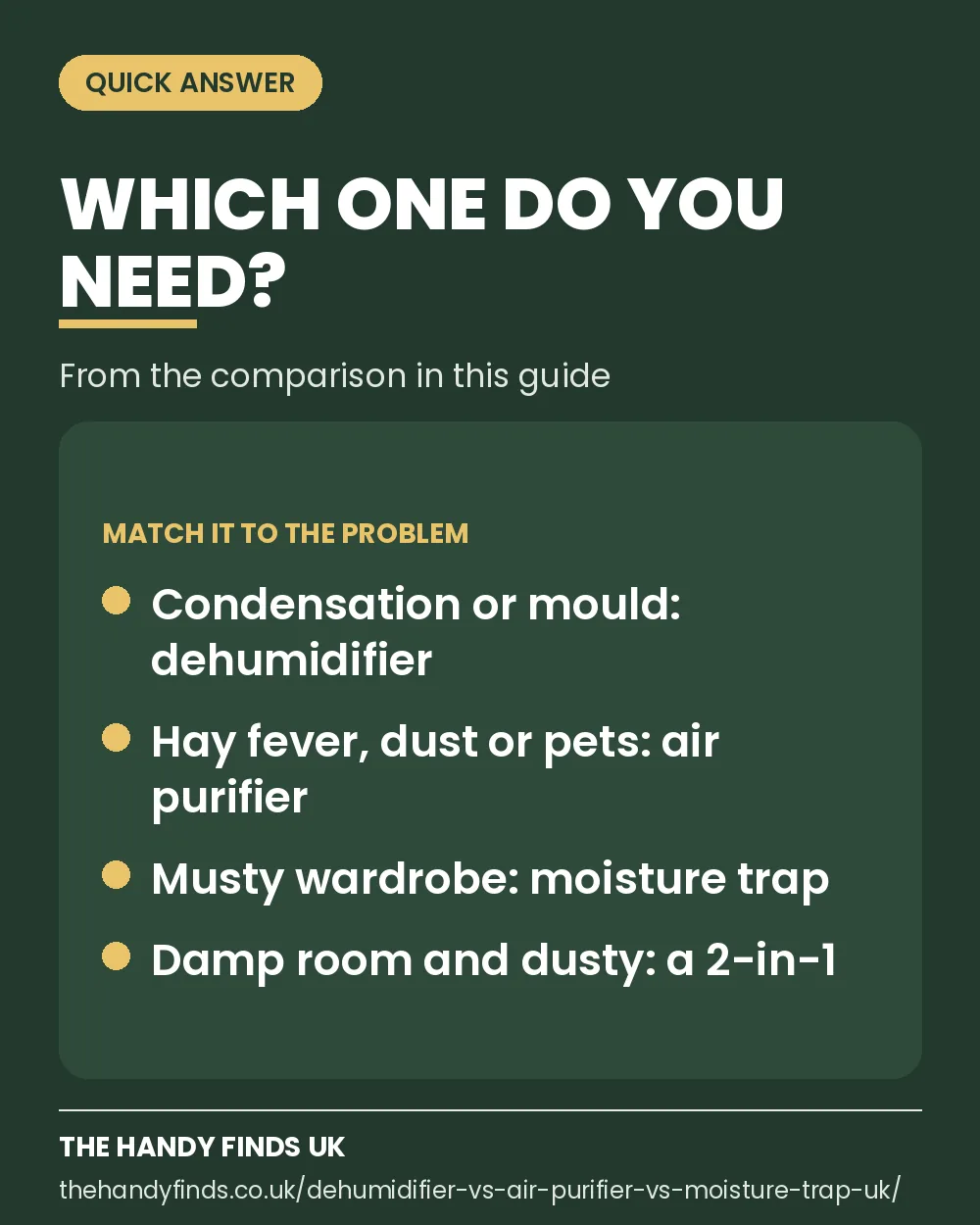
So for damp and mould, the answer is almost always a dehumidifier, with moisture traps as a top-up for cupboards and wardrobes. An air purifier is for allergies and dust, though some dehumidifiers include a purifier filter too. Below we compare them side by side, with running costs at 26.32p per kWh.
Who this guide is for: Anyone deciding what to buy for condensation, a damp or musty room, mould, allergies or dust. If you rent and the damp is persistent, report it to your landlord as well: GOV.UK's guidance says landlords are responsible for addressing damp and mould.
Side by side: what each one does
| Dehumidifier | Air purifier | Moisture trap | |
|---|---|---|---|
| What it does | Pulls water out of the air into a tank | Filters particles out of the air | Crystals soak up a little moisture |
| Lowers humidity? | Yes | No (AEG) | Slightly, in a small enclosed space |
| Helps with mould? | Yes: removes the damp mould needs | Only catches spores in the air | Only in cupboards and wardrobes |
| Dust, pollen, pet dander | No, unless it has a filter | Yes | No |
| Running cost (picks here) | 3.6p an hour (136W) to 15.3p (580W) | 0.9p an hour (33W) | No power; refill tabs |
| Best for | Condensation, damp rooms, mould, drying washing | Allergies, dust, pets, smoke | Wardrobes, cupboards, stored caravans |
Running costs use 26.32p per kWh, the Ofgem price cap average for 1 October to 31 December 2026: watts ÷ 1,000 × 26.32 = pence per hour.
Damp, condensation or mould: get a dehumidifier
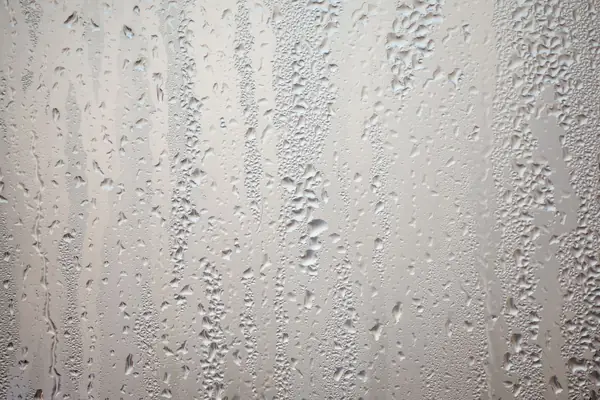
Mould grows where moisture sits, and GOV.UK's guidance says condensation is the most common cause of damp in homes. Only a dehumidifier (or better ventilation and heating) removes that moisture. An air purifier won't: AEG says a purifier removes particles from the air, not humidity, and the NRLA's explainer says the same.
Choose a compressor model for a normally heated home, where it's cheapest to run, and a desiccant model for cold rooms, garages and conservatories. Our guides to the best dehumidifiers, desiccant dehumidifiers and dehumidifiers for a bedroom compare the options.
Allergies, dust or pets: get an air purifier
If your problem is hay fever, dust, pet dander or smoke, an air purifier is the right tool. Look for a HEPA filter, and check the room size it's rated for. A purifier with a carbon filter can also reduce smells, but if the smell is musty, find the damp first: see our guide to a damp smell in the house.
A purifier can catch mould spores in the air, which some people with allergies find helpful while the cause is being fixed. It won't stop mould growing on a damp wall.
A musty cupboard or wardrobe: a moisture trap may be enough
For a small enclosed space with still air, such as a wardrobe on an outside wall, an under-stairs cupboard or a caravan in storage, a moisture trap is cheap and silent. Check how fast it fills. If the tray fills within days, the whole room is damp and needs a dehumidifier.
Leave a gap between furniture and outside walls, as GOV.UK suggests, and only put clothes away fully dry. Our guide to mould on clothes covers rescuing anything that's already gone musty.
Can one machine do both?
Yes. Several dehumidifiers, including Meaco's Arete range, have a HEPA filter built in and an air purification mode. That suits a damp bedroom where you'd also like cleaner air. For damp alone, any dehumidifier will do the job, and for dust alone, a dedicated purifier usually covers a bigger room for less power.
One of each, and a 2-in-1
How we chose: We based the comparison on manufacturer guidance (AEG and Meaco), the NRLA's explainer, Which?'s dehumidifier buying advice and GOV.UK's damp and mould guidance. Running costs use the makers' wattages and Ofgem's October to December 2026 price cap. Every product was re-checked on Amazon UK and Meaco on 29 October 2026. We haven't tested these products ourselves. These products have not been tested hands-on; this is a research-based roundup. How the research works.
Products compared
| Pick | Type | Removes water? | Filters particles? | Cost per hour* | Where to buy |
|---|---|---|---|---|---|
| Meaco Arete Two 10LBest 2-in-1 for a damp room | Compressor dehumidifier with H13 HEPA filter | Yes, 4.19L/day at 20°C/60% | Yes (H13 HEPA) | 3.6p (136W) | Meaco Amazon |
| Levoit Core 300Best air purifier for dust and allergies | HEPA air purifier | No | Yes (3-stage HEPA) | 0.9p (33W) | Check price |
| UniBond AERO 360Best moisture trap | Non-electric moisture absorber | A little, into a tray | No | None (refill tabs) | Check price |
| EcoAir DD1 Simple MK3Best for a cold room | Desiccant dehumidifier | Yes, up to 7.5L/day | No | 7.9p–15.3p (300–580W) | Check price |
| TempPro TP50 hygrometerBest for deciding | Digital hygrometer | No (measures humidity) | No | None (1 × AAA battery) | Check price |
Specs are from manufacturer listings as of 29 October 2026; claimed figures (running costs, runtimes) are the maker’s, not ours. Check the retailer’s page for the current price and exact variant before you buy.
MeacoDry Arete Two 10L Dehumidifier & HEPA H13 Air Purifier
Best for: A damp bedroom or flat where you'd also like cleaner air
- Type
- Compressor dehumidifier with H13 HEPA filter
- Removes water?
- Yes, 4.19L/day at 20°C/60%
- Filters particles?
- Yes (H13 HEPA)
- Cost per hour*
- 3.6p (136W)
If you have damp and want cleaner air too, a 2-in-1 saves buying two machines. Meaco's Arete Two 10L is a compressor dehumidifier with a medical-grade H13 HEPA filter built in, and Meaco lists an air purification mode among its settings. At 136W (Meaco's figure at 20°C/60%) it costs about 3.6p an hour (0.136 × 26.32). It has a humidistat, app and voice control, and a 5-year warranty.
Its extraction is modest at 4.19 litres a day at 20°C/60%, so it suits a flat or one problem room. It was in stock at Meaco and on Amazon (sold by Meaco UK) when we checked on 29 October 2026. For bigger homes, see our dehumidifier guide.
What owners and reviewers like
- Dehumidifier and purifier in one
- Low running cost
- 5-year warranty (Meaco)
Watch-outs
- Modest extraction for a big, damp house
- Small 2.5L tank
Check price at Meaco Also on Amazon Affiliate links · open meaco.com (via Awin) or Amazon.co.uk
Levoit Core 300 HEPA air purifier
Best for: Pollen, dust and pet dander in a bedroom or living room
- Type
- HEPA air purifier
- Removes water?
- No
- Filters particles?
- Yes (3-stage HEPA)
- Cost per hour*
- 0.9p (33W)
If your problem is hay fever, dust or pet dander rather than damp, an air purifier is the tool. Levoit's Core 300 is one of Amazon UK's most-reviewed purifiers. Its listing says the 3-stage HEPA filter captures 99.97% of particles as small as 0.3 microns, including pollen, dust, pet dander, mould spores and smoke, and that it has four fan speeds, a 2 to 8-hour timer and a 24dB sleep mode. It's listed at 33W, so about 0.9p an hour at full power (0.033 × 26.32 = 0.87p). It was sold by Amazon when we checked.
It doesn't take any water out of the air, so it won't fix condensation or the damp that mould needs. Levoit also sells an optional mould filter, but it only catches spores in the air: the mould on the wall will keep growing until the damp is fixed.
What owners and reviewers like
- Very low running cost
- Quiet sleep mode
- Choice of replacement filters
Watch-outs
- Does nothing for damp or condensation
- Replacement filters are an ongoing cost
Check current price on Amazon Affiliate link · opens Amazon.co.uk
UniBond AERO 360° Moisture Absorber, device with 1 refill tab (450g)
Best for: Wardrobes, cupboards, under-stairs spaces and caravans in storage
- Type
- Non-electric moisture absorber
- Removes water?
- A little, into a tray
- Filters particles?
- No
- Cost per hour*
- None (refill tabs)
A moisture trap is the right size of tool for a small enclosed space with still air. The UniBond AERO 360 needs no power and draws water out of the air into a tray. UniBond says it suits spaces up to 20m² and that a refill tab lasts up to three months, depending on how damp the space is. It was sold by Amazon when we checked, as are the 4-pack of refill tabs.
It absorbs far less than an electric dehumidifier, so it won't dry a damp bedroom. If the tray fills within days, the room needs a dehumidifier.
What owners and reviewers like
- No power, no noise
- Ideal for enclosed spaces
- Sold by Amazon
Watch-outs
- Absorbs far less than a dehumidifier
- Refills are an ongoing cost
Check current price on Amazon Affiliate link · opens Amazon.co.uk
EcoAir DD1 Simple MK3 desiccant dehumidifier
Best for: Unheated rooms, garages and conservatories where a compressor model struggles
- Type
- Desiccant dehumidifier
- Removes water?
- Yes, up to 7.5L/day
- Filters particles?
- No
- Cost per hour*
- 7.9p–15.3p (300–580W)
Compressor dehumidifiers slow down in cold rooms, which Which? notes in its buying advice. A desiccant model keeps working, and blows out slightly warm air. The DD1 Simple has a single rotary dial, a laundry setting and weighs 6kg. At EcoAir's 300W low and 580W high settings it costs about 7.9p to 15.3p an hour (0.300 × 26.32 = 7.90; 0.580 × 26.32 = 15.27). It was sold by Amazon when we checked.
It costs more to run than a compressor model in a heated room, so use it where the cold is the problem. Our desiccant dehumidifiers guide has more choices.
What owners and reviewers like
- Works in cold rooms
- Simple dial control
- Light at 6kg
Watch-outs
- Higher running cost than a compressor model
- No humidity readout
Check current price on Amazon Affiliate link · opens Amazon.co.uk
TempPro (formerly ThermoPro) TP50 Digital Thermo-Hygrometer
Best for: Finding out whether you actually have a humidity problem
- Type
- Digital hygrometer
- Removes water?
- No (measures humidity)
- Filters particles?
- No
- Cost per hour*
- None (1 × AAA battery)
Before you buy anything, measure. A hygrometer shows whether a room is humid enough to need a dehumidifier. The TP50 shows temperature and relative humidity, records highs and lows, and has a simple dry, comfortable or wet face. It was sold by TempPro UK and dispatched by Amazon when we checked.
If a room stays above about 60–65% for long periods in winter, a dehumidifier is the answer. If humidity is normal but you're sneezing, look at a purifier instead.
What owners and reviewers like
- Cheap
- Min/max memory
- Shows whether a fix is working
Watch-outs
- No app or alerts on this model
Check current price on Amazon Affiliate link · opens Amazon.co.uk
We use MailerLite to send emails. See our privacy policy.
FAQs
Does an air purifier get rid of damp?
No. An air purifier filters particles such as dust, pollen and mould spores out of the air, but AEG says it removes only particles, not humidity. For damp and condensation you need a dehumidifier, better ventilation, or both.
Is a dehumidifier or air purifier better for mould?
A dehumidifier, because it removes the moisture mould needs to grow. An air purifier can catch spores floating in the air but won't stop mould growing on a damp surface.
Do moisture traps actually work?
Yes, in small enclosed spaces such as wardrobes and cupboards. They absorb far less than an electric dehumidifier, so they won't dry out a damp room. If one fills within days, the room needs a dehumidifier.
Can a dehumidifier also purify the air?
Some can. Meaco's Arete range, for example, has an H13 HEPA filter built in and lists an air purification mode. A standard dehumidifier without a filter doesn't purify the air.
Which is cheaper to run, a dehumidifier or an air purifier?
At the October 2026 price cap of 26.32p per kWh, the 33W Levoit Core 300 purifier costs about 0.9p an hour and the 136W Meaco Arete Two 10L dehumidifier about 3.6p. Desiccant dehumidifiers cost more, about 7.9p to 15.3p an hour for the EcoAir DD1 Simple.
Do I need a dehumidifier or a humidifier?
If you have condensation, a musty smell or mould, you need a dehumidifier: the air is too damp. A humidifier adds moisture and is only for air that's too dry, which is rare in UK homes in winter.
Do you get commission?
Yes. If you buy through our links, Amazon or Meaco (via Awin) may pay us a small commission at no extra cost to you. It doesn't affect which products we include. See our Affiliate Disclosure.
- AEG: will the air in the room get dry when using an air purifier?
- NRLA: air purifier vs dehumidifier
- Which?: how to buy the best dehumidifier
- GOV.UK: understanding and addressing the health risks of damp and mould in the home
- Ofgem: energy price cap unit rates, 1 October to 31 December 2026
- Meaco: MeacoDry Arete Two 10L specifications
Prices change constantly, so we don’t list them here. Always check the current price, seller and delivery details on the retailer’s site before buying. If anything on this page looks wrong or out of date, let me know.