Is it cheaper to heat one room with an electric heater than to put the central heating on?
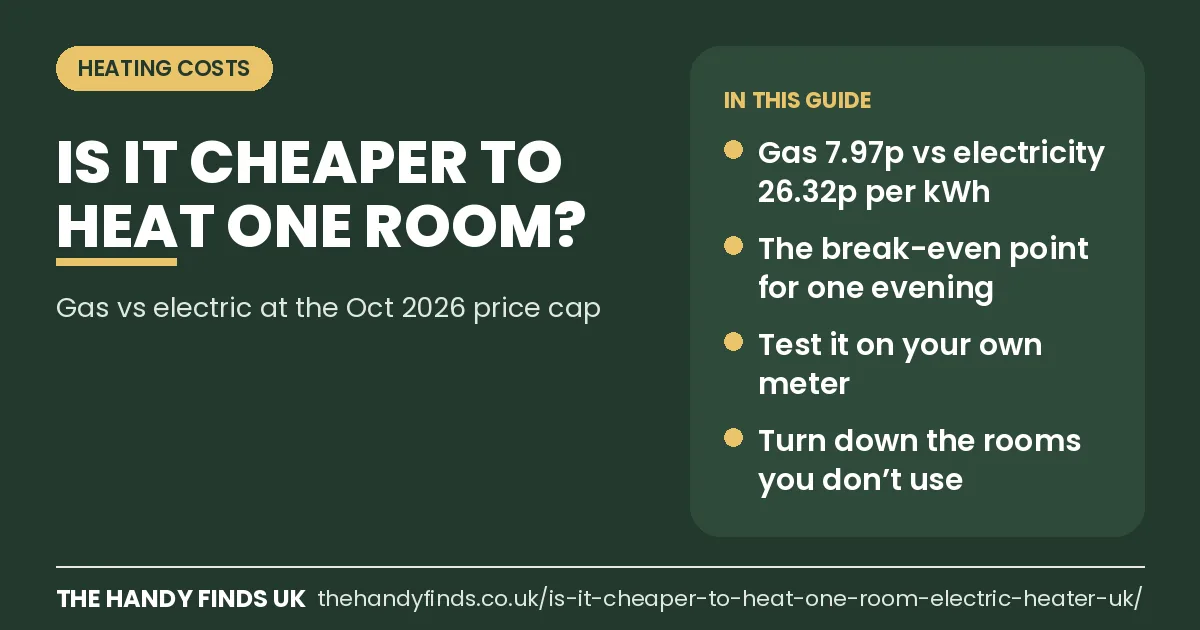
Electricity costs about three times as much as gas per unit of heat, so an electric heater only wins when you'd otherwise heat a lot of empty rooms. Here's the working at the October to December 2026 price cap, and a simple meter test to settle it for your home.

It's one of the most-asked heating questions every winter: if you're only using the living room, is it cheaper to plug in an electric heater than to fire up the boiler for the whole house? The honest answer is sometimes, but less often than people think.
At the October to December 2026 price cap, electricity costs 26.32p per kWh and gas 7.97p per kWh. An electric heater turns all of its electricity into heat, while a modern gas boiler turns about 90% of its gas into heat. Even so, a unit of heat from electricity costs roughly three times as much as one from gas. So a heater only comes out ahead when your central heating would warm a lot of rooms you aren't using.
Below we show the sums, the break-even point for a typical evening, a simple meter test you can do yourself, and the cheaper middle ground most people overlook: turning the radiators down in empty rooms. If you'd rather warm yourself than the room, a heated throw costs pennies an hour.
Who this guide is for: Anyone with gas central heating who spends most evenings in one room, works from home in a spare room, or wants to know whether a plug-in heater will save money. If your home is all-electric with no gas, the comparison is different: see our electric radiators guide instead.
Gas vs electric: the cost of a unit of heat
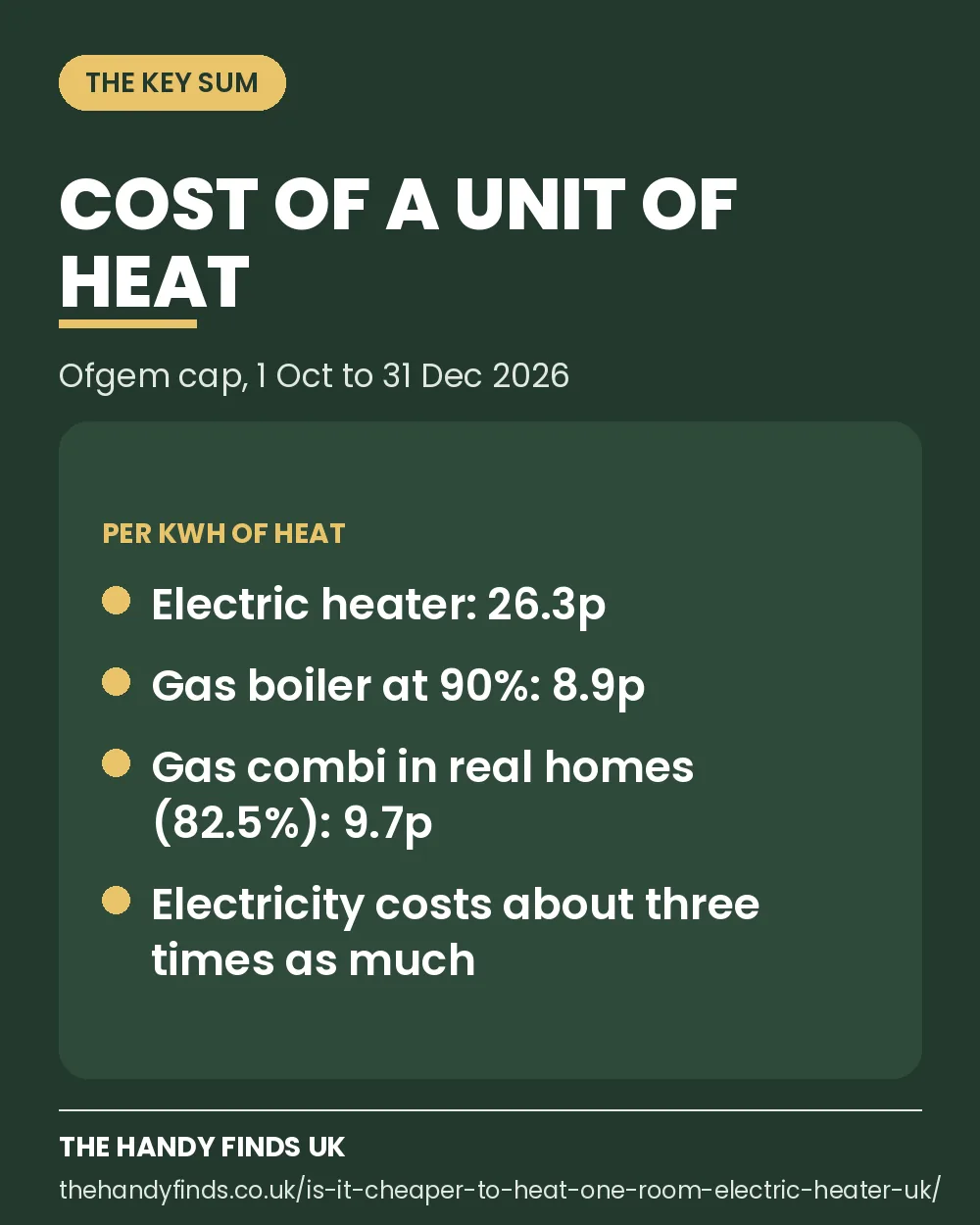
Here's the core sum, using Ofgem's average price cap unit rates for 1 October to 31 December 2026 (Direct Debit, England, Scotland and Wales).
| Heat source | Unit rate | Efficiency | Working | Cost per kWh of heat |
|---|---|---|---|---|
| Electric heater (any type) | 26.32p | 100% | 26.32 ÷ 1.00 | 26.3p |
| Gas boiler at its rating | 7.97p | 90% | 7.97 ÷ 0.90 = 8.86 | 8.9p |
| Gas combi boiler in real homes | 7.97p | 82.5% | 7.97 ÷ 0.825 = 9.66 | 9.7p |
So a unit of heat from an electric heater costs about three times as much as from a new boiler running at its rating (26.32 ÷ 8.86 = 2.97), and about 2.7 times as much using the real-world figure (26.32 ÷ 9.66 = 2.72). British Gas says every new UK boiler is at least 90% efficient. The 82.5% figure comes from an Energy Saving Trust field trial of condensing combi boilers, which found they ran below their ratings in real homes. An older non-condensing boiler would narrow the gap further.
One thing the sum doesn't change: you pay the daily gas standing charge (29.68p at the October 2026 cap) whether the boiler runs or not, so it doesn't count against central heating in this comparison.
The break-even point for one evening
Say you run a 1.5kW heater flat out for four hours: 1.5 × 4 = 6kWh, and 6 × 26.32 = 157.9p, or about 158p. A thermostat will usually cut that, but use it as the worst case.
For the gas central heating to cost the same, the boiler would have to burn 157.9 ÷ 7.97 = 19.8kWh of gas over those four hours. So:
- If your boiler would burn more than about 20kWh of gas to heat the whole house for that evening, the electric heater is cheaper.
- If it would burn less, the central heating is cheaper, and the rest of the house stays warm too.
A 700W heater at full power for four hours uses 2.8kWh, or about 74p (2.8 × 26.32 = 73.7). The gas break-even for that is 73.7 ÷ 7.97 = 9.2kWh. A heated throw at 100W for four hours is about 10.5p, which central heating can't match.
Test it on your own meter
Every home is different, so the most reliable answer comes from your own meter. It takes two evenings:
- Evening one, central heating: read your gas meter (or the in-home display on a smart meter) when the heating comes on and again when it goes off. Most UK gas meters read in cubic metres. Your bill shows the conversion to kWh, which is usually about 11 times the cubic metres.
- Evening two, one heater: leave the heating off and run the heater in one room for the same hours, reading the electricity meter before and after.
- Compare: gas kWh × 7.97p against electricity kWh × 26.32p (or your own tariff's rates).
Try to pick two evenings with similar weather, and remember that a house that has gone cold takes more gas to warm back up the next day.
The cheaper middle ground: turn down the rooms you don't use
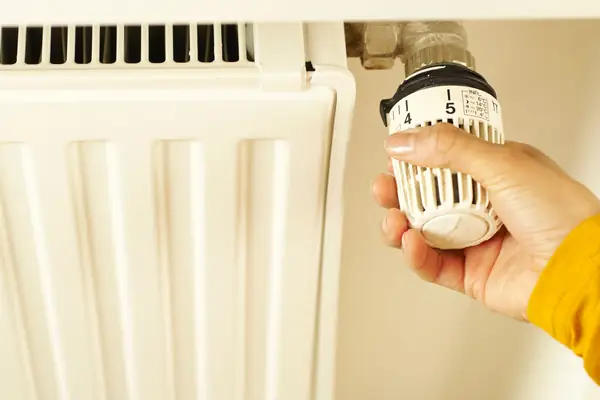
You don't have to choose between heating the whole house and heating one room. The Energy Saving Trust suggests setting thermostatic radiator valves (TRVs) lower in the rooms you use less, and higher in the rooms you use most. Turning empty rooms down, rather than off, keeps gas heating's cost advantage while cutting how much of the house you heat.
It also says it's usually best not to leave rooms completely unheated for long periods in cold weather, because some background heat helps reduce the risk of condensation and mould. If you already see wet windows in the morning, our guides to condensation on windows and condensation in a bedroom explain why.
Cheap draught-proofing helps whichever option you choose. A brush or seal on the front door and a draught excluder on the living room door stop the warm air you've paid for escaping.
When an electric heater does make sense
- You're home alone in one room in a larger house, and the rest of the house would otherwise be heated for nobody.
- You work from home in a spare room during the day and the central heating would otherwise run all day.
- You need a short burst of heat, such as half an hour in a bathroom or a cold box room.
- You have no gas, or your boiler is broken.
If you do use one, Electrical Safety First's advice is to plug a portable heater straight into a wall socket rather than an extension lead, which can easily be overloaded, to keep it at least one metre from curtains, furniture and paper, never to dry clothes on or close to it, and not to leave it on unattended or while you're asleep. Choose one with a thermostat and a timer so it doesn't run flat out for longer than it needs to.
Heaters and warmers for one room
How we chose: We used Ofgem's average price cap unit rates for 1 October to 31 December 2026, boiler efficiency figures from British Gas and an Energy Saving Trust field trial, and the makers' wattages for each product. Heating advice comes from the Energy Saving Trust and safety advice from Electrical Safety First. Every product was re-checked on Amazon UK on 29 October 2026. We haven't measured anyone's home, so use the meter test below to check your own. These products have not been tested hands-on; this is a research-based roundup. How the research works.
Running costs compared
| Pick | Type | Power (maker) | Cost per hour* | Best for | Amazon |
|---|---|---|---|---|---|
| Dimplex Eco Chico (700W)Best small top-up heater | Oil-free mini radiator | 700W | 18.4p at full power | Small rooms | Check price |
| Dreo 1500W ceramic heaterBest for quick heat | Ceramic fan heater | 1.5kW | 39.5p at full power | Small to medium rooms | Check price |
| De'Longhi Radia S (2kW)Best for a bigger room | Oil-filled radiator | 2kW | 52.6p at full power | Living rooms up to 60m³ (De'Longhi) | Check price |
| Beurer HD75 heated throwCheapest way to stay warm | Heated throw | 100W | 2.6p | One person on a sofa or chair | Check price |
| Dreamland Cosy DreamerBest for a cold bedroom | Electric underblanket | Not stated on the listing | Not worked out (no wattage listed) | Double beds, couples | Check price |
Specs are from manufacturer listings as of 29 October 2026; claimed figures (running costs, runtimes) are the maker’s, not ours. Check the Amazon page for the current price and exact variant before you buy.
Dimplex Eco Chico 700W oil-free mini radiator
Best for: Taking the chill off a small bedroom, study or box room
- Type
- Oil-free mini radiator
- Power (maker)
- 700W
- Cost per hour*
- 18.4p at full power
- Best for
- Small rooms
If you only need a small room a few degrees warmer, a low-wattage heater keeps the cost down. The Eco Chico is a 700W mini radiator with a dial thermostat and a slim freestanding base. At full power it costs about 18.4p an hour (0.7 × 26.32), and less once the thermostat starts cycling. Dimplex gives it a three-year guarantee, and it was sold by Amazon when we checked on 29 October 2026.
At 700W it's a top-up, not a way to heat a cold living room from scratch, and there's no timer. For more choices, see our oil-filled radiators guide.
What owners and reviewers like
- Low power, so low hourly cost
- Near-silent oil-free element (Dimplex)
- 3-year guarantee
Watch-outs
- Too small for a big, cold room
- No timer
Check current price on Amazon Affiliate link · opens Amazon.co.uk
Dreo 1500W ceramic heater with digital thermostat and remote
Best for: Warming a home office or living room quickly, then holding the temperature
- Type
- Ceramic fan heater
- Power (maker)
- 1.5kW
- Cost per hour*
- 39.5p at full power
- Best for
- Small to medium rooms
Ceramic heaters warm the air fast, which suits a room you only use for a few hours. The Dreo has a digital thermostat you can set from 5°C to 35°C in 1°C steps, an ECO mode, a 12-hour timer, tip-over protection and a remote. At full power it costs about 39.5p an hour (1.5 × 26.32). It was sold by Amazon when we checked.
The thermostat is what saves money: once the room reaches your setting, it cuts back. The heat also fades quickly once it's off, so it isn't the right choice for keeping a room warm all day. More options are in our ceramic heaters guide.
What owners and reviewers like
- Fast heat-up
- Precise digital thermostat
- 12-hour timer and remote
Watch-outs
- Heat fades soon after it switches off
- Fan noise, though Dreo quotes 34dB
Check current price on Amazon Affiliate link · opens Amazon.co.uk
De'Longhi Radia S 2kW oil-filled radiator with digital thermostat and timer
Best for: Keeping a living room warm for a whole evening
- Type
- Oil-filled radiator
- Power (maker)
- 2kW
- Cost per hour*
- 52.6p at full power
- Best for
- Living rooms up to 60m³ (De'Longhi)
Oil-filled radiators warm up more slowly but hold their heat, which suits a whole evening in one room. The Radia S has a digital thermostat, an Eco Plus mode, an anti-frost setting and a timer you can set from 30 minutes to 24 hours. De'Longhi rates it for rooms up to 60m³. At its full 2kW it costs about 52.6p an hour (2 × 26.32), less once the thermostat takes over. It was sold by Amazon when we checked.
At that rate, a few hours on full power soon costs more than gas central heating for a small home, so use the thermostat and timer. It's heavy at 10.6kg, but has castors. Compare it with others in our oil-filled radiators guide.
What owners and reviewers like
- Holds heat well
- Digital thermostat and 24-hour timer
- Anti-frost setting
Watch-outs
- Highest running cost here at full power
- Heavy
Check current price on Amazon Affiliate link · opens Amazon.co.uk
Beurer HD75 heated throw, 180 × 130cm
Best for: Staying warm on the sofa or at a desk without heating the room
- Type
- Heated throw
- Power (maker)
- 100W
- Cost per hour*
- 2.6p
- Best for
- One person on a sofa or chair
Heating yourself rather than the air is by far the cheapest option. The HD75 is rated at 100W, so it costs about 2.6p an hour (0.1 × 26.32), or about 10.5p for a four-hour evening. It has six heat settings, automatic switch-off and Beurer's overheat protection, and it's machine washable. It was sold by Amazon when we checked.
It won't stop a room getting cold, and a very cold room can get damp, so keep a little background heat on in winter. More options are in our heated throws guide.
What owners and reviewers like
- About 2.6p an hour
- Six heat settings
- Auto switch-off
Watch-outs
- Warms you, not the room
- Some owners want a hotter top setting
Check current price on Amazon Affiliate link · opens Amazon.co.uk
Dreamland Cosy Dreamer dual-control electric blanket, double
Best for: Warming the bed instead of heating the bedroom overnight
- Type
- Electric underblanket
- Power (maker)
- Not stated on the listing
- Cost per hour*
- Not worked out (no wattage listed)
- Best for
- Double beds, couples
If the bedroom is the problem, warm the bed. The Cosy Dreamer has two controllers with six settings each, heats up in about five minutes (Dreamland's figure), and switches off after 1, 3 or 9 hours. It's machine washable once you detach the controllers, comes with a three-year guarantee and was sold by Amazon when we checked.
The Amazon listing doesn't give a wattage, so we haven't worked out a running cost. Electric blankets are low-power compared with any room heater, though. More choices are in our electric blankets guide.
What owners and reviewers like
- Dual controls
- 1, 3 or 9-hour auto-off
- 3-year guarantee
Watch-outs
- Wattage not listed
- Warms the bed, not the room
Check current price on Amazon Affiliate link · opens Amazon.co.uk
We use MailerLite to send emails. See our privacy policy.
FAQs
Is it cheaper to heat one room with an electric heater?
Only if your central heating would otherwise heat a lot of empty rooms. At the October to December 2026 price cap, a unit of heat from electricity costs about 26.3p, against about 8.9p from a 90%-efficient gas boiler. For a 1.5kW heater running four hours (about 158p), the boiler would have to burn more than about 20kWh of gas over the same time for the heater to win.
How much does a 2kW electric heater cost to run per hour?
About 52.6p an hour at full power at the October 2026 price cap of 26.32p per kWh (2 × 26.32). A thermostat will usually bring that down once the room is warm.
Is gas or electric heating cheaper in the UK?
Gas, per unit of heat. At the October 2026 cap, gas is 7.97p per kWh and electricity 26.32p. After allowing for boiler efficiency, heat from gas costs roughly a third as much.
Should I turn the radiators off in rooms I don't use?
Turn them down rather than off. The Energy Saving Trust suggests keeping rooms you use less at a lower temperature, but says it's usually best not to leave rooms completely unheated for long periods in cold weather, because some background heat helps reduce the risk of condensation and mould.
What is the cheapest way to heat one room?
Heat yourself rather than the room if you can: a 100W heated throw costs about 2.6p an hour. If you need the room warm, turn down the radiators in rooms you aren't using and keep gas heating where it is cheaper, or use a small heater with a thermostat.
Can I plug an electric heater into an extension lead?
Electrical Safety First advises against it. Portable heaters draw a lot of current and can overload an extension lead, so plug them straight into a wall socket.
Do you get commission?
Yes. If you buy through our links, Amazon may pay us a small commission at no extra cost to you. It doesn't affect which products we include. See our Affiliate Disclosure.
Prices change constantly, so we don’t list them here. Always check the current price, seller and delivery details on Amazon before buying. If anything on this page looks wrong or out of date, let me know.