Ceramic heater vs oil-filled radiator: which is cheaper to run in the UK?
Watt for watt they cost exactly the same per hour. What changes the bill is how long you run them and how well they hold a room at temperature. Here are the sums at the October to December 2026 price cap, plus six in-stock heaters with their hourly costs.

Quick answer
Neither is cheaper per hour at the same wattage: a 2kW ceramic heater and a 2kW oil-filled radiator both cost about 52.6p an hour on full power at the Ofgem price cap of 26.32p/kWh (1 October to 31 December 2026). Best overall for a whole evening in one room: De'Longhi Radia S oil-filled radiator, because its thermostat, Eco Plus mode and 0.5 to 24-hour timer let it cycle off while the warm oil keeps giving out heat. For short bursts of under an hour, a ceramic heater such as the Dreo 1500W (about 39.5p an hour on full power) is the better buy, because it puts out warm air straight away.
Last updated: · Stock checked: (the picks named here were in stock on Amazon.co.uk; prices change daily, so we don’t list them)
It's one of the most common heating questions: is an oil-filled radiator cheaper to run than a ceramic (fan) heater? The honest answer starts with a rule that surprises people. Every plug-in electric heater turns all of the electricity it uses into heat (the Centre for Sustainable Energy calls them 100% efficient). So a 2kW ceramic heater and a 2kW oil-filled radiator use the same 2kWh in an hour on full power and cost the same.
The difference is how they deliver that heat. A ceramic heater blows air over a hot ceramic element, so it warms you within minutes and stops the moment you switch it off. An oil-filled radiator heats oil sealed inside metal fins: Electrical Safety First says it takes longer to warm up but keeps giving out heat after it switches off, and is generally more economical to run. That's why the right choice depends on how long you need heat. For more on heating a single room, see our cheapest way to heat one room guide.
Who this guide is for: Anyone choosing between a ceramic heater and an oil-filled radiator for a home office, bedroom or living room, or wondering which of the two they already own is cheaper to leave on. If you only need to warm yourself, not the room, see our electric blanket vs heated throw running costs first: they cost pennies an hour.
Ceramic heater vs oil-filled radiator: the cost per hour
These are my own sums at Ofgem's average electricity unit rate of 26.32p per kWh for 1 October to 31 December 2026 (rechecked on ofgem.gov.uk on 11 November 2026). The formula is simply kilowatts × unit rate. They are the most each wattage can cost when running flat out.
| Power | 30 minutes | 1 hour | 4 hours |
|---|---|---|---|
| 350W desk heater | 4.6p | 9.2p | 37p |
| 1kW (radiator on low) | 13.2p | 26.3p | 105p |
| 1.5kW (ceramic or radiator) | 19.7p | 39.5p | 158p |
| 2kW (ceramic or radiator) | 26.3p | 52.6p | 211p |
| 2.5kW (large radiator) | 32.9p | 65.8p | 263p |
Working: 2kW × 26.32p = 52.64p an hour; four hours is 4 × 52.64 = 211p. The same 2kW costs the same whether it comes from a ceramic element or from oil-filled fins.
So why do people say oil-filled radiators are cheaper?
Because of how they behave over a long spell, not because they turn electricity into heat more efficiently. Once a room reaches the temperature you set, the thermostat switches the element off and on. The warm oil and fins carry on giving out heat while the element is off, which evens out the warmth. The Centre for Sustainable Energy says oil-filled radiators are often the cheapest convector heaters because there is a thermostat to control the temperature, and Electrical Safety First describes them as generally more economical to run.
As an illustration only: if a 2kW heater's thermostat keeps the element on for half of each hour, it averages about 26.3p an hour instead of 52.6p. How much it actually cycles depends on the room size, insulation, draughts and the weather, so treat that as an example, not a promise.
A ceramic heater with a good thermostat cycles too, so a thermostat-controlled ceramic heater isn't automatically dearer. What a ceramic heater can't do is keep warming the room after it switches off.
Which is cheaper for short bursts?
- Under an hour: a ceramic heater. It gives heat immediately, so you're not paying while a radiator full of oil slowly warms up, and you can switch it off the moment you leave the room. A lower-wattage model such as the 1.5kW Dreo also caps the hourly cost below a 2kW radiator.
- A whole evening in one room: an oil-filled radiator with a thermostat and timer. Set the timer so it starts before you sit down, then let the thermostat hold the temperature.
- Just you at a desk: neither. A 350W desk heater (about 9.2p an hour), a heated throw or an electric blanket warms the person rather than the air, for a fraction of the cost. Out of doors or in a cold workshop, a heated gilet or rechargeable hand warmers cost pennies to charge.
Is a plug-in heater cheaper than gas central heating?
Sometimes, for one room. The Centre for Sustainable Energy says that if only one or two people are at home and staying in the same room for a while, an oil-filled radiator may work out cheaper than running gas central heating for that time. It also warns that running a high-wattage fan heater for a long time may well cost more than having the central heating on. Gas is 7.97p per kWh at the current cap against 26.32p for electricity, so heating a whole house with plug-in heaters is expensive. Our is it cheaper to heat one room with an electric heater guide goes into this in more detail.
Safety: what Electrical Safety First advises
- Keep any heater at least one metre from anything that can burn, such as curtains, paper and furniture, and stand it on a level surface where it can't be knocked over.
- Fan and ceramic heaters blow intense hot air, so keep the vents clear. Oil-filled radiator fins can stay hot after use, so keep children away until they've cooled.
- Never leave a heater on unattended or while you're asleep, never dry clothes on or close to one, and don't plug a heater into an extension lead.
- Every portable heater must have a UK 3-pin plug. Buy from a reputable retailer, avoid second-hand heaters and register yours so you hear about any recall.
Ceramic heaters and oil-filled radiators mentioned here
How we chose: I took the wattage of each heater from its Amazon.co.uk listing on 11 November 2026 (opened with a UK delivery postcode, SW1A 1AA, with an add-to-basket button present) and multiplied it by Ofgem's average electricity price cap unit rate for 1 October to 31 December 2026: 26.32p per kWh, rechecked on ofgem.gov.uk on 11 November 2026. Those are the most each heater can cost per hour at full power. Real use is lower once the thermostat starts switching the element on and off, but how much lower depends on your room, insulation and the weather, so I haven't invented a single real-world figure. How each type behaves comes from Electrical Safety First and the Centre for Sustainable Energy. Pros and cons are recurring themes in Amazon.co.uk owner feedback. I haven't used or tested these heaters. These products have not been tested hands-on; this is a research-based roundup. How the research works.
What each heater costs per hour at full listed power
| Pick | Type | Power (listing) | Per hour at full power | 4 hours at full power | Amazon |
|---|---|---|---|---|---|
| De'Longhi Radia S 2kWBest overall for long evenings | Oil-filled radiator | 2kW | 52.6p | 211p | Check price |
| Dreo 1500W ceramicBest ceramic heater for short bursts | Ceramic (PTC) fan heater | 1.5kW | 39.5p | 158p | Check price |
| Russell Hobbs 2kW ceramicBest ceramic for a bigger room | Oscillating ceramic heater | 2kW | 52.6p | 211p | Check price |
| De'Longhi Capsule Desk 350WCheapest to run per hour | Mini ceramic heater | 350W | 9.2p | 37p | Check price |
| Russell Hobbs 7-fin 1.5kWBest low-wattage oil-filled radiator | Oil-filled radiator, 7 fins | 600W / 900W / 1.5kW | 39.5p (15.8p on 600W) | 158p | Check price |
| Pro Breeze 11-fin 2.5kWBiggest oil-filled radiator here | Oil-filled radiator, 11 fins | 1kW / 1.5kW / 2.5kW | 65.8p (26.3p on 1kW) | 263p | Check price |
Specs are from manufacturer listings as of 11 November 2026; claimed figures (running costs, runtimes) are the maker’s, not ours. Check the Amazon page for the current price and exact variant before you buy.
De'Longhi Radia S 2kW oil-filled radiator (TRRS0920E.G)
Best for: Keeping a living room or large bedroom warm for a whole evening
Our verdict: De'Longhi Radia S 2kW oil-filled radiator (TRRS0920E.G) (Best overall for long evenings) is best for keeping a living room or large bedroom warm for a whole evening. Listed specs: Type: Oil-filled radiator; Power (listing): 2kW; Per hour at full power: 52.6p.

- Type
- Oil-filled radiator
- Power (listing)
- 2kW
- Per hour at full power
- 52.6p
- 4 hours at full power
- 211p
The Radia S has a digital thermostat, an Eco Plus mode that the listing says picks a comfort level from the room temperature, an anti-frost setting and a timer you can set from 30 minutes to 24 hours. De'Longhi says the oil keeps releasing heat for a while after it switches off. It's rated for rooms up to 60m³, weighs 10.6kg and comes with folding castors already fitted. At its full 2kW it costs at most about 52.6p an hour (2 × 26.32); once the room is up to temperature the thermostat cycles it, so it costs less. Sold and dispatched by Amazon when I checked on 11 November 2026.
In Amazon.co.uk feedback, owners say it warms rooms quickly and efficiently, is easy to set up and use, and helps them save on energy bills; several mention the range of thermostat settings and an easy-to-use timer. Compare it with other models in our best oil-filled radiators guide.
What owners and reviewers like
- Digital thermostat plus Eco Plus mode
- Timer from 30 minutes to 24 hours
- Keeps giving out heat after it cycles off
Watch-outs
- Heavy at 10.6kg
- Slower to warm a cold room than a ceramic heater
- Fins stay hot after use
Check current price on Amazon Affiliate link · opens Amazon.co.uk
Dreo Atom 316 1500W ceramic heater with thermostat and remote
Best for: A quick warm-up of a home office or bedroom for an hour or so
Our verdict: Dreo Atom 316 1500W ceramic heater with thermostat and remote (Best ceramic heater for short bursts) is best for a quick warm-up of a home office or bedroom for an hour or so. Listed specs: Type: Ceramic (PTC) fan heater; Power (listing): 1.5kW; Per hour at full power: 39.5p.

- Type
- Ceramic (PTC) fan heater
- Power (listing)
- 1.5kW
- Per hour at full power
- 39.5p
- 4 hours at full power
- 158p
A compact ceramic heater with a thermostat you can set from 5°C to 35°C in 1°C steps, Power Heat, ECO and fan-only modes, a 12-hour timer, a remote, tip-over and overheat protection and a child lock. Dreo lists the noise at 34dB. At full power it costs at most about 39.5p an hour (1.5 × 26.32), and because it's only 1.5kW, it costs less per hour on full than a 2kW oil-filled radiator. Sold and dispatched by Amazon when I checked on 11 November 2026.
Owners say it heats a room quickly, works well in small to medium rooms, is easy to use and runs cheaply as a top-up to the heating; many compare its size to a kettle. More choices are in our best ceramic heaters guide.
What owners and reviewers like
- Heat straight away
- Precise 1°C thermostat
- Lower 1.5kW maximum than most radiators
Watch-outs
- Heat fades as soon as it stops
- Fan noise, though listed at 34dB
- Too small for a large living room
Check current price on Amazon Affiliate link · opens Amazon.co.uk
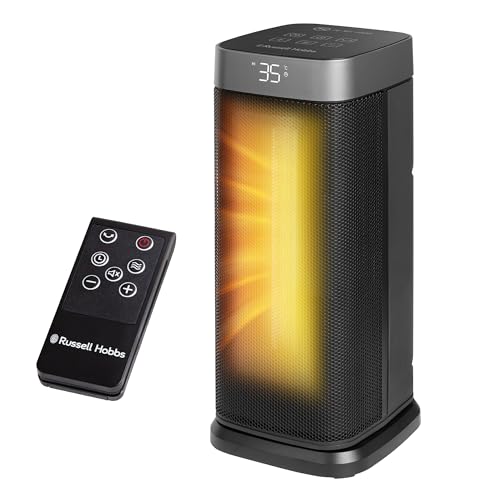
Russell Hobbs 2kW oscillating ceramic heater (RHCTH2002S)
Best for: Fast heat across a living room or double bedroom
Our verdict: Russell Hobbs 2kW oscillating ceramic heater (RHCTH2002S) (Best ceramic for a bigger room) is best for fast heat across a living room or double bedroom. Listed specs: Type: Oscillating ceramic heater; Power (listing): 2kW; Per hour at full power: 52.6p.
- Type
- Oscillating ceramic heater
- Power (listing)
- 2kW
- Per hour at full power
- 52.6p
- 4 hours at full power
- 211p
A 2kW oscillating ceramic heater with a digital thermostat from 5°C to 36°C, five modes (high, low, ECO, max and fan only), a 24-hour timer, tip-over and overheat protection and a child lock. Russell Hobbs says it suits spaces up to 20m² and gives a two-year guarantee when you register it. At its full 2kW it costs at most about 52.6p an hour, exactly the same as a 2kW oil-filled radiator. Sold and dispatched by Amazon when I checked on 11 November 2026.
Owners say it warms a room quickly, with one saying it was toasty in about ten minutes, and find the remote and controls easy to use. Noise gets mixed comments: some call it super quiet, others noisy.
What owners and reviewers like
- Oscillates to spread heat
- Thermostat, ECO mode and 24-hour timer
- Two-year guarantee on registration
Watch-outs
- Same 52.6p an hour as a 2kW radiator on full
- Mixed comments on noise
- No stored heat once it's off
Check current price on Amazon Affiliate link · opens Amazon.co.uk
De'Longhi Capsule Desk 350W mini ceramic heater (HFX10B03.GR)
Best for: Warming yourself at a desk rather than the whole room
Our verdict: De'Longhi Capsule Desk 350W mini ceramic heater (HFX10B03.GR) (Cheapest to run per hour) is best for warming yourself at a desk rather than the whole room. Listed specs: Type: Mini ceramic heater; Power (listing): 350W; Per hour at full power: 9.2p.
- Type
- Mini ceramic heater
- Power (listing)
- 350W
- Per hour at full power
- 9.2p
- 4 hours at full power
- 37p
A small desk heater with a 350W maximum, a thermostat knob from 5°C to 28°C, an angled front grille, tip-over switch-off, a safety thermostat and a thermal fuse. At most it costs about 9.2p an hour (0.35 × 26.32), a fraction of any full-size heater, because it's designed to warm the person sitting in front of it. Sold and dispatched by Amazon when I checked on 11 November 2026.
Owners like the compact, retro look and say it heats small spaces quickly and cheaply, with one quoting about 11p an hour. Several say it isn't powerful enough to heat a room.
What owners and reviewers like
- Lowest hourly cost here
- Small enough for a desk
- Tip-over switch-off
Watch-outs
- Won't heat a whole room
- No timer
- Dial thermostat only
Check current price on Amazon Currently unavailable on Amazon.co.uk (checked 18 November 2026): check the listing before you buy.Affiliate link · opens Amazon.co.uk
Russell Hobbs 1.5kW 7-fin oil-filled radiator (RHOFR5001, white)
Best for: A small bedroom or box room on a lower setting
Our verdict: Russell Hobbs 1.5kW 7-fin oil-filled radiator (RHOFR5001, white) (Best low-wattage oil-filled radiator) is best for a small bedroom or box room on a lower setting. Listed specs: Type: Oil-filled radiator, 7 fins; Power (listing): 600W / 900W / 1.5kW; Per hour at full power: 39.5p (15.8p on 600W).

- Type
- Oil-filled radiator, 7 fins
- Power (listing)
- 600W / 900W / 1.5kW
- Per hour at full power
- 39.5p (15.8p on 600W)
- 4 hours at full power
- 158p
A compact oil-filled radiator with three heat settings (600W, 900W and 1.5kW), a variable thermostat, overheat and tip-over protection, castors and a 1.45m cable. Russell Hobbs says it suits spaces up to 15m² and offers a second year of guarantee when you register it. Costs at most: about 15.8p an hour on 600W, 23.7p on 900W and 39.5p on 1.5kW. There's no timer. Sold and dispatched by Amazon when I checked on 11 November 2026. On 20 November 2026 the black version was only available used, so the link now goes to the same model in white, which was in stock and sold by Amazon.
Owners like the glossy finish and say it's good for small spaces and costs little to run. Heat output and reliability get mixed comments: some say it barely warms a room, and some say it stopped working after a few weeks.
What owners and reviewers like
- Three wattages, down to 600W
- Small and light for an oil-filled radiator
- Sold by Amazon
Watch-outs
- No timer
- Too small for larger rooms
- Mixed reliability comments
Check current price on Amazon Affiliate link · opens Amazon.co.uk
Pro Breeze 2.5kW 11-fin oil-filled radiator with 24-hour timer
Best for: A large, draughty room that needs heat for hours
Our verdict: Pro Breeze 2.5kW 11-fin oil-filled radiator with 24-hour timer (Biggest oil-filled radiator here) is best for a large, draughty room that needs heat for hours. Listed specs: Type: Oil-filled radiator, 11 fins; Power (listing): 1kW / 1.5kW / 2.5kW; Per hour at full power: 65.8p (26.3p on 1kW).

- Type
- Oil-filled radiator, 11 fins
- Power (listing)
- 1kW / 1.5kW / 2.5kW
- Per hour at full power
- 65.8p (26.3p on 1kW)
- 4 hours at full power
- 263p
An 11-fin oil-filled radiator with three settings (1kW, 1.5kW and 2.5kW), an adjustable thermostat, a 24-hour timer, tip-over and overheat cut-outs, four wheels and a cable tidy. At its full 2.5kW it costs at most about 65.8p an hour, the highest here, so it pays to use the lower settings and the thermostat: 1kW is about 26.3p an hour. Sold by One Retail Group and dispatched by Amazon when I checked on 11 November 2026.
Owners say it warms rooms quickly, like the timer and find it easy to put together. Durability is the worry: several say it broke within a couple of months or stopped working.
What owners and reviewers like
- Plenty of power for big rooms
- 24-hour timer
- 1kW setting for gentler heat
Watch-outs
- Most expensive per hour on full
- Durability complaints
- Third-party seller (Amazon dispatch)
Check current price on Amazon Affiliate link · opens Amazon.co.uk
We use MailerLite to send emails. See our privacy policy.
FAQs
Is a ceramic heater cheaper to run than an oil-filled radiator?
Not per hour at the same wattage. A 2kW ceramic heater and a 2kW oil-filled radiator both cost about 52.6p an hour on full power at the Ofgem cap of 26.32p per kWh (1 October to 31 December 2026). A ceramic heater is usually cheaper for short bursts because it heats straight away; an oil-filled radiator is usually cheaper over a long evening because it holds its heat while the thermostat cycles it off.
Which is cheaper to leave on all evening?
Usually an oil-filled radiator with a thermostat and timer, such as the De'Longhi Radia S. Its oil keeps giving out heat when the element switches off, and both Electrical Safety First and the Centre for Sustainable Energy describe oil-filled radiators as generally the more economical choice for longer use.
How much does a 2kW oil-filled radiator cost per hour?
At most about 52.6p an hour on full power at 26.32p per kWh (2 × 26.32). Once the room reaches the temperature you set, the thermostat switches it off and on, so the real average is lower.
How much does a ceramic heater cost to run per hour?
Its wattage times the unit rate: about 9.2p for a 350W desk heater, 39.5p for a 1.5kW model and 52.6p for a 2kW model on full power at the current cap.
Do oil-filled radiators use less electricity?
No, not watt for watt. All plug-in electric heaters turn 100% of their electricity into heat. An oil-filled radiator saves money only by running less often once the room is warm, thanks to the thermostat and stored heat.
Is a ceramic heater or oil-filled radiator better for a bedroom?
For warming a bedroom for an hour before bed, a ceramic heater with a timer works well and heats quickly. For keeping a bedroom warm for longer, an oil-filled radiator on a low setting with a thermostat is quieter and gives steadier heat. Electrical Safety First advises against leaving either on unattended or while you're asleep, so use the timer to switch it off before you sleep.
When does the price cap change?
Ofgem's current cap runs from 1 October to 31 December 2026. A new cap starts on 1 January 2027, and I'll update these figures when it's announced.
Do you earn commission?
Yes. If you buy through Amazon links on this page I may earn a commission at no extra cost to you (tag thehandyfinds-21). It doesn't affect which heaters appear. See the affiliate disclosure.
Prices change constantly, so we don’t list them here. Always check the current price, seller and delivery details on Amazon before buying. If anything on this page looks wrong or out of date, let me know.